Tuesday, August 22, 2006

Fuelling the Middle East conflict

From Lord Avebury P0622083

Tel 020-7274 467

Email ericavebury@gmail.com

August 22, 2006

Dear Mr Ingram,

Could you please explain why the Government are not only increasing arms sales to Israel, but also supplying night vision equipment to Iran which ends up with Hezbollah in Lebanon?

According to The Guardian of April 6, 2006 (see attached article Huge jump in arms sales to Israel), military export licences for Israel almost doubled last year, and now it is revealed (see article from yesterday’s Times attached British Kit found in Hezbollah Bunkers) that at the same time we have been supplying equipment that is of crucial importance to Israel’s mortal enemies.

These policies are profoundly at variance with the aim of achieving a lasting peace in the Middle East, and in the case of Iran, the award of the licence for night vision equipment was also a breach of our own export guidelines (see attached SaferWorld press release Hezbollah night-vision allegations highlight loophole in UK arms export monitoring). Iran has supported Hizbollah has been going on for years, so did it not occur to officials that there was a material risk of diversion to a known illegal client?

I hope the investigation of the sale of night vision equipment will be widened to cover all sales of military and dual use equipment to Israel, Iran and Syria. One immediate contribution we could make to consolidating the fragile peace in Lebanon would be to suspend all shipments of such equipment, and all issues of licences, to the region.

Yours sincerely,


The Rt Hon Adam Ingram MP,

Floor 5, Main Building,
Ministry ofDefence,
Whitehall,
London SW1A 2HB


Huge jump in arms sales to Israel

· Military export licences to country almost double
· Government accused of arming repressive regimes


Richard Norton-Taylor
Thursday April 6, 2006
The Guardian

The number of arms export licences granted for countries the government accuses of human rights abuses increased significantly over the past year, the latest official figures show.

They also show that licences for weapons sales to Saudi Arabia increased by 25% last year, to £25m. They included sales of assault rifles, riot control equipment and body armour.

Licences for British arms sales to Israel last year amounted to nearly £25m, almost double the previous year. The licences covered the export of armoured vehicles and missile components.

Quarterly annual figures appear separately on the Foreign Office website and were collated by the Campaign Against the Arms Trade (Caat), which alerted the Guardian to them. They show that licences were also approved for sales of arms valued at more than £12.5m to Indonesia. Amnesty International last year reported extrajudicial killings carried out by Indonesian security forces in Aceh and West Papua. British-made armoured vehicles were reported to have been deployed against protesters in West Papua in November last year.

Israel, Saudi Arabia and Indonesia are among 11 out of 20 countries described by the FO in its 2005 annual human rights report as "major countries of concern" to which the government licensed military equipment.

The sales cleared for Israel are the highest since 1999. This was before Jack Straw, the foreign secretary, sought assurances from Israel that equipment supplied by the UK was not being used against civilians and in the occupied territories. In 2002 the government said it was tightening controls on arms exports to the country after it found that assurances had been breached.

The increase in arms export licences to Saudi Arabia came at a time the government was negotiating an agreement, worth an estimated £8bn to BAE Systems, to equip Saudi Arabia's armed forces with Typhoon combat aircraft, formerly known as the Eurofighter.

Indonesia is now regarded as an ally against Islamist extremism and Tony Blair held out the prospect of more British weapons sales on his recent visit to the country.

Britain last year licensed military equipment sales to 14 of the 17 countries involved in major armed conflict, Caat said yesterday. It added that Britain had also licensed weapons equipment to 10 countries at the bottom third of the UN human development index.

The FO said last night that all exports were considered under the government's official criteria. "The bottom line is that no piece of kit is used for external aggression or internal repression," it said, adding that it believed the government's arms export licensing system was stringent and transparent.

"The government has committed itself to leading international negotiations on an arms trade treaty to stop global arms flows to war zones and repressive regimes," Mike Lewis of Caat said yesterday. "Yet in the last twelve months it has licensed weapons exports precisely to these regimes ... The government must stop arming the world's human rights abusers."


The Times August 21, 2006

AN URGENT investigation was launched last night after Israel accused Britain of indirectly supplying Hezbollah terrorists with military night-vision equipment that helped them to target Israeli soldiers in Lebanon.

The equipment was found by Israeli troops in Hezbollah command bunkers in southern Lebanon. Each set was stamped “made in Britain”.

The Israelis made representations to the Foreign Office after it was revealed that Britain had sold 250 night-vision systems to Iran in 2003 for use against drug smugglers.

Foreign Office officials said early indications seemed to suggest that the night-vision equipment found by the Israelis was not part of the batch sold in 2003 to Iran. However, thorough checks were being made to compare serial numbers on the equipment found in the Hezbollah bunkers with those on the ones exported legitimately to Iran.

The Iranians are the prime sponsor of Hezbollah, and the Israeli authorities are demanding to know whether the equipment sold to Iran three years ago ended up in the hands of Hezbollah, which killed 117 Israeli soldiers during the month-long clashes in Lebanon.

A Department of Trade and Industry official said night-vision equipment of military specification required an export licence. The investigation will look into whether any British company might have breached export regulations.

The batch of 250 night-vision systems were given a special export licence in 2003 because they were intended to be used by Iranian police trying to stem the flow of heroin and opium from Afghanistan into Iran. Although there is what amounts to an arms embargo against Iran, aimed principally at stopping the export of equipment that could benefit Tehran’s suspected nuclear weapons programme, the request for night-vision equipment was approved in recognition of the counter-narcotics work.

When the export was agreed, Mike O’Brien, then Junior Minister at the Foreign Office, told the Commons: “The goods are for the use on the Iran-Afghanistan border against heroin smugglers.” He said there was “no risk of these goods being diverted for use by the Iranian military”.

If any of the equipment has been diverted to Hezbollah, it would be a serious embarrassment for the Government. Hezbollah’s “external security”, the military wing of the militant organisation, is proscribed as a terrorist group. The Government has also made clear its support for Israel’s struggle with Hezbollah and has approved the transit of bunker-busting bombs and missiles for the Israelis from the US through British airports.

Liam Fox, the Shadow Defence Secretary, said: “If this turns out to be true, and Iran supplied backing for Hezbollah, it will have consequences for any future military exports to Iran. And it points the finger all the more strongly at Iranian involvement in destabilising the Middle East.”

One set of the equipment was found by Israeli forces in the southern Lebanon village of Mis-a-Jebel on August 10, in a house belonging to a 60-year-old man whose four sons are all Hezbollah fighters.

One was described as a Thermo-vision 1000 LR system with a serial number 155010, part number 193960. Other equipment, including radios also thought to be British, and sophisticated recording and monitoring devices, were found.

Israeli commanders had complained that night-time operations in the border region had been hampered by the ability of Hezbollah fighters to observe and counter their moves. In more than six days of fighting around the village of Mis-a-Jebel, the Israelis lost six soldiers and 20 more were injured.

Lieutenant-Colonel Olivier Radowicz, an Israeli commander, said: “The night-vision unit was used to observe the movement of troops. You can also record what you are watching. Then it is connected to a computer. You can obtain a perfect intelligence picture in real time. It is then connected to firing systems.”


SaferWorld - For immediate release – 22 August 2006

Hezbollah night-vision allegations highlight loophole in UK arms export monitoring

British military night-vision equipment, originally sold to Iran, has allegedly been found in Hezbollah’s possession. This highlights the need for the UK Government to more effectively monitor the final destination and use of its arms exports. (1)

Under the UK Government's own arms export criteria, it is obliged to consider "the existence of a risk that the equipment will be diverted within the buyer country or re-exported under undesirable conditions"(2) when deciding on whether to license an export.

Yet, the UK Government does not have a formal system for checking what happens to arms exports after they have been licensed and left the UK. Introducing such a system would allow the Government to verify delivery and monitor end-use to ensure that exported British military equipment is used as intended – and not diverted elsewhere or used for other purposes. The Government has previously argued that such a system would be impractical, but other countries operate them (3). Earlier this month, a joint committee of MPs called on the Government to look at introducing a system. (4)

Saferworld is urging the Government to close this loophole and establish a formal system of end-use monitoring when it conducts its five-year review of the Export Control Act next year. In the interim, the Government should redouble efforts to ensure that it enforces existing regulations to prevent transfers of weapons or other strategic goods to unintended end users.

“This incident demonstrates that the UK Government needs to do more to ensure that it knows for certain who, in the end, will be using the arms its exports. The Government should listen to MPs and campaigners who have been calling for a system for doing this to be introduced and close this loophole.” said Claire Hickson, Head of Communications and Advocacy at Saferworld.

ENDS

For further information, please contact:

Sonia Rai, Advocacy and Policy Officer, Saferworld

Tel: + 44 (0) 207 324 4646; Mobile + 44 (0) 7931 340 733

Claire Hickson, Head of Advocacy and Communications, Saferworld

Tel: +44 (0)207 324 4646; Mobile: +44 (0) 7867 780 072
(1) British Kit found in Hezbollah Bunkers, The Times, 21 August 2006.
(2) Criterion 7 UK Government Consolidated Criteria.
(3) For example, United States has the State Department “Blue Lantern programme” and the Department of Defence “Golden Sentry programme”, which operate on the principle that where a particular transfer trips a number of “red flags”, checks on end-use are carried out. In 2004, the State Department performed 530 Blue Lantern checks, with 93 ‘unfavourable determinations.
(4) Strategic Export Controls: Annual Report for 2004, Quarterly Reports for 2005, Licensing Policy and Parliamentary Scrutiny, August 2006, HC873

Ostriches and Alcohol - letter to the Prime Minister

From Lord Avebury P0618082

Tel 020-7274 4617

Email ericavebury@gmail.com

August 18, 2006

I wrote to the Home Secretary on June 25 and July 1 about alcohol harm, asking among other things why the Government is unwilling to produce an annual update of the Strategy Unit Alcohol Harm Reduction project’s Interim Analytical Report of September 2003 (IAR), so that the £20 billion cost to the nation[1] could be recalculated using the same methodology, and the effects of the Government’s Alcohol Harm Reduction Strategy thereby assessed. Vernon Coaker’s reply didn’t address that question, and it has been dodged also when I have put questions in Parliament.

Consumption of alcohol increased from 4,930 hectolitres of pure alcohol in 2001-02 (the year to which the £20 billion figure is assumed to relate) to 5,613 HLPA in 2004-05[2], and if this rate of increase has been maintained, it will reach 6,068 HLPA in the current year, 2006-07. If harm increases in proportion to consumption, as many experts believe[3], the increase in harm since the Cabinet Office estimate would be 10.8%, a staggering £4.62 billion.

The actual figure is likely to be even higher, because the extension of drinking hours arising from the Licensing Act is certain to have boosted consumption. As we said at the time, the operators of licensed premises are not so stupid as to open for longer hours unless they were reasonably certain of recouping the overheads incurred by higher sales. ACPO say it is too early to draw any conclusions about the effects on law and order of the Act, but in December 2005 and June 2006 there were major enforcement campaigns by the police, which limited disorder.

The Government decided not to tackle consumption through price and availability, the two main levers ‘traditionally cited.. as influencing levels of .. consumption and therefore reducing alcohol misuse’[4], on the spurious ground that other factors such as culture and advertising also have an effect. Therefore in addition to the phenomenon of binge drinking, which is facilitated by the proliferation of late night outlets and the relative cheapness of alcohol, drink-driving convictions are rising, and the Department of Transport says that drivers with blood alcohol levels of 50-80 mg/ml are a significant but largely hidden cause of accidents[5]

The Hospital Episode Statistics published by the DH show that in 2001-02, admissions to hospital with a primary diagnosis of mental and behavioural disorders due to the use of alcohol (classification F10) were 32,462, while in 2004-05 the number was 43,907[6]. Taking these figures as a proxy for the NHS cost of dealing with alcohol-related harm, that cost would be up by 35.3%.

I submit that these calculations demonstrate the necessity for the Government to take effective measures to reduce alcohol harm, in particular by raising the level of excise duties, and to assess the costs to the nation by updating the IAR estimates annually. Since any increase in alcohol duties could encourage smuggling, we should also encourage other EU member states to raise their taxation of alcohol towards ours, and to conduct audits of harm using the same methodology. Government Departments should set an example by reducing the amount they spend on alcohol, and eliminating alcohol altogether from daytime events.

The Rt Hon Tony Blair,

Prime Minister,

10 Downing Street,

London SW1A 2AA.


[1] Cabinet Office, Alcohol misuse: How much does it cost, September 2003, p 58 [www.strategy.gov.uk/downloads/files/SU%20interim_report2.pdf]

[2] HM Revenue & Customs, Annual Report 2004-05, Table F1, December 2005

[3] Thor Norstrom (ed) European Comparative Alcohol Study, ECAS 1, 2002, p 214 and Hakan Leifman, Esa Osterberg & Mats Ramstedt, Alcohol in Postwar Europe, ECAS II, 2002, para 8.1 (www.fhi.se/upload/PDF/English?ecas_2.pdf

[4] Cabinet Office, op cit, 152.

[5] Combating Drink Driving: Next Steps. A consultation paper, DETR, February 1998

[6] www.hesonline.nhs.uk/Ease/servlet/ContentServer?siteID=1937&categoryID=203

Monday, August 21, 2006

An unsolved murder?

Today I had a visit from Serhat Tepe, younger brother of the late Ferhat Tepe, who was the Bitlis correspondent of the Kurdish newspaper Özgur Gündem. He was kidnapped in Bitlis by four men, one of whom had a walkie-talkie, at 19.00 on July 28, 1993 and found dead a few days later at the neighbouring town of Elazig. When I visited his father Isak Tepe on October 14, 1993, he told me:

'Since Ferhat's body was found, the police continually put the family and people who offer us condolences under surveillance. Anonymous callers threaten us on the telephone. I gave a description of the kidnappers, but we all know it was the police themselves who murdered him. An hour before he was kidnapped the police came to my office and asked one of my colleagues for Ferhat. Later, the police told my colleague, Adnan Karsoglu, that if he said anything about them coming and asking about Ferhat, he would be killed himself. Adnan knew one of them by sight and would recognise him if he saw him'.

'There has been no official investigation of my son's death. When his body was found, they sent me to Elazig, totally the wrong direction. The head of security in Bitlis told me to collect the body by myself but, suspecting a trap, I took some friends with me. The police said his body had been found in water, suggesting that he had been drowned, but I saw the marks of torture on his body, including blood all over his sexual organs'.

This and other murders of journalists and political activists at the time were attributed to a shadowy organisation named Hizbollah, but there was plenty of circumstantial evidence pointing to state agents as the killers.

As a result of four visits I made to investigate the situation in the Kurdish region in the nineties, I was banned from entering the country from June 1996 onwards, and have still had no indication from the Turkish authorities that I am now free to go there without restrictions.

With Serhat Tepe today

Friday, August 18, 2006

No regard for the UN Convention on the Rights of the Child

Breastfeeding mothers detained away from babies

Matt Weaver
Friday August 18, 2006
Guardian Unlimited

Breastfeeding mothers are being separated from their babies for several days in the government's drive to deport failed asylum seekers, Guardian Unlimited can reveal today.

Immigration officials have been accused of flouting several UN conventions by detaining mothers away from pre-weaned infants in at least two cases this spring.

In March this year a Vietnamese mother was seized from her Birmingham home without notice. She was then locked up at the immigration removals centre at Yarl's Wood in Bedfordshire, without her six-month-old baby.

The woman, known only as Mrs N, was due to be sent back to Vietnam, even though she was married to a British citizen and the authorities were aware that they had a child.

She was reunited with the baby after a last-minute reprieve allowing her to stay in the UK to challenge the decision. She had no contact with the baby for four days.

Following complaints about the case the immigration minister, Liam Byrne, suggested it was an isolated incident. He said the correct procedures on the treatment of families had not been properly followed.

But it has now emerged that in April a second breastfeeding mother was also detained in Yarl's Wood without her child. This case involves Mrs P, a Turkish asylum seeker, who is married to a fellow Turk who has been granted refugee status.

She was taken to the detention centre after a routine weekly visit to sign on at an immigration centre in central London. She had left her 15-month-old boy with a minder after being asked on previous visits not to bring him to the centre.

Doctors had advised Mrs P to continue breastfeeding the child because he had a kidney condition.

During interviews at the centre, immigration officials had remarked on the dampness of her clothing from her leaking breasts. She pointed out that her baby would not take formula milk from a bottle.

But she was told that she had no legal right to stay in the UK and was taken to Yarl's Wood pending deportation. She spent two nights there before being reunited with her child after a last-minute reprieve to allow her to appeal.

In a statement to her lawyer, Mrs P said: "I have had terrible experiences in Turkey, but this was worse. I thought constantly of my son. I cried all the time. It has taken my son some time to settle down after my return. His sleep pattern was disturbed and his behaviour deteriorated."

In both cases the change of heart from the authorities came after the intervention of the veteran human rights campaigner and Liberal Democrat peer Lord Avebury.

He said: "It's reasonable to assume that these are not the only cases. It is shocking that the Home Office does not have a policy on the detention of breastfeeding mothers and the separation from their children. They ought to have one that absolutely forbids it."

In a letter to Lord Avebury about Mrs N's treatment, Mr Byrne said a review of the case had revealed that officials had mistakenly ignored Home Office procedure.

He said: "It is clear that the case was not satisfactorily handled. Prechecks had failed to reveal that Mrs N was part of a family unit. The staff involved in Mrs N's case have been reminded on the guidance in place about making decisions involving the separation of a family."

Last month Lord Avebury wrote to Mr Byrne seeking an explanation for Mrs P's treatment. He has also asked for the Home Office to look into how many similar cases there have been. He has yet to receive a reply.

Annette Elder, the solicitor for both women, pointed out that if the cases had involved criminal proceedings proper childcare arrangements would have been made before the children were separated from their mothers.

Patti Rundall, the policy director of the charity Baby Milk Action, said both cases "fly in the face of a number of UN resolutions and conventions".

She cited the Global Strategy on Infant and Young Child Feeding, the Innocenti Declaration on the Protection, Promotion and Support of Breastfeeding, and the Convention on the Rights of the Child, which all stress the importance of breastfeeding to the nutrition and welfare of children.

Ms Rundall added: "There seems to have been no regard for or understanding of the needs and rights of the child or mother."

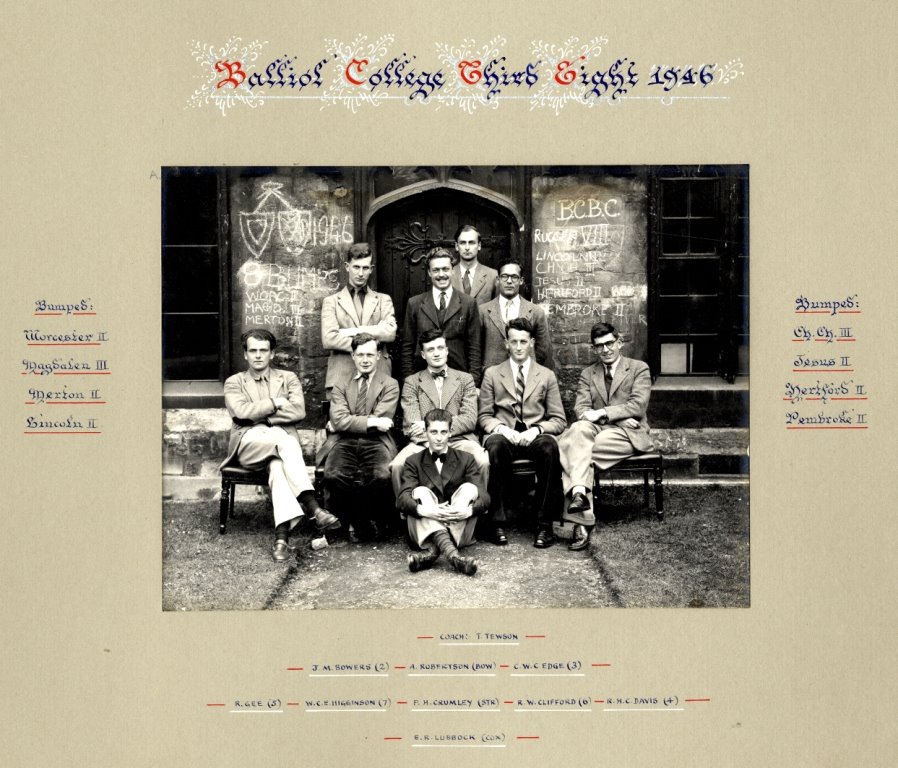
Balliol College Rugger Eight 1946

Thursday, August 17, 2006

Abkhazia

From Lord Avebury P0617081

Tel 020-7274 4617

Email ericavebury@gmail.com

August 17, 2006

Dear Geoff,

I attach an English-language version of the Key to the Future, a document prepared by the Abkhaz authorities on the resolution of their constitutional status. The Georgians have also produced a road map, and while neither of these documents provide a basis for compromise, being more a reiteration of their previously held positions, there should be a concerted attempt by the international community to get them together to see if discussion of the documents can lead to some reduction of tension and progress on the methodology of finding a permanent solution,

The Russian Foreign Minister has said that the introduction of Georgian armed forces into the upper part of the Kodori gorge was a gross violation of the 1994 Moscow Accords, and that the presence of the so-called government in exile there was a change for the worse. The UNOMIG military condemned the incursion immediately, though not their political colleagues, who may have been mindful of the need to preserve their relationship with Tbilisi. However, Condoleeza Rice’s adviser on the Caucasus, Matthew Bryza, takes the opposite view, for reasons which are not clear, and the US representative at the OSCE has been making false allegations about alleged Abkhazian threats of action they would take if the Georgian troops are not withdrawn. No threats have been made, and it is highly irresponsible for a highly placed US official to make an allegation of this nature. The Georgians have said they want the Russian peacekeepers to be withdrawn, and in particular they will not allow them to participate in the monitoring of the Kodori Gorge scheduled for August 20. (Kavkas-Press, Tbilisi, August 16, 2006).

There may be some leverage over the Georgians because they are expecting to progress their membership action plan at the NATO Summit to be held in Riga November 28-29. What action are you taking, via the OSCE or bilaterally, to ensure that the troops are withdrawn; that UNOMIG are allowed back into the Gorge, and that an international inquiry is launched to ascertain responsibility for this crisis, and to recommend compensation for those who suffered unlawful detention or other violations of their human rights by the Georgian forces, as detailed in the attached report of the Georgian Human Rights Information and Documentation Centre?

The Rt Hon Geoff Hoon,

Foreign & Commonwealth Office,

London SW1A 2AH.


The Key to the Future

The aim of this plan is a final political, comprehensive settlement of the Georgian-Abkhaz conflict and the development of cardinally new, good-neighbourly relations between once-hostile states. The processes of economic integration in the Black Sea region and prospects for more intensive economic and regional cooperation within the framework of the “European Union’s broad neighbourhood strategy” [as published] could become the guarantors of the bilateral affirmation by the sides of their commitment towards the fundamental principles of good-neighbourly relations.

The basis of the plan consists of measures for restoring trust, which is why the demonstration of good will by both sides will be the key to a future stable peace. The strengthening of trust will be achieved only by ending military rhetoric and by augmenting peace initiatives, which must move from theory to implementation.

Historical prerequisites

Taking into account the specific nature of Georgian-Abkhaz relations, which largely stems from the Stalin era, there is a need to first and foremost renounce the ambitions and stereotypes of that period. The political acts that were carried out by Georgia in the Communist period were of a discriminatory nature, artificially underestimated the ethnic Abkhaz population [figure], changed Abkhaz toponymy and hydronymy and transformed Abkhaz statehood. These facts, which cannot be denied, prove that the policy was purposefully aimed at the assimilation of the Abkhaz ethnic group.

During the rule of the Georgian Mensheviks (1918-1921), a military dictatorship was established in Abkhazia, which is confirmed by many sources stored in various archives worldwide. In 1925, Shalva Eliava, a Georgian political leader, admitted: “Throughout the entire period of rule of Menshevik government in Georgia there were systematic violations of the rights of the Abkhaz people and attempts by the ‘democratic’ Georgian government to turn Abkhazia into an object of exploitation, rule it directly, dispose of the republic’s entire assets - land, forests, and valuable real estate – for the purposes of the policy of settling there themselves.”

The Georgian leadership’s purposeful, consistent policy of assimilating ethnic Abkhaz was to result in them losing their ethnic identity altogether.

After Stalin’s death in 1953, the Central Committee of the Georgian Communist Party also denounced the policy which the Georgian leadership implemented towards the ethnic Abkhaz at its August 1956 plenary session.

The preliminary investigative materials form the Republic of Abkhazia Prosecutor’s Office on mass killings, genocide, and other grave crimes committed during the occupation of Abkhazia by the Georgian authorities and their armed formations in 1992 – 1993 also confirm that the policy of the Georgian leadership was aimed at creating a mono-ethnic state.

Georgian leader Eduard Shevardnadze said at the 11th plenary session of the Georgian Communist Party Central Committee on 27 June 1978: “it has to be said straight out that, in the past, during the period which we all know, a policy was being implemented towards the Abkhaz people that may effectively be described as chauvinist. Let us call things by their names. That policy, in its very essence, came into conflict with the interests of both the Georgian and Abkhaz people.”

It follows from that statement that, clearly, the capability for internal self-revision and admission of one’s own mistakes has always existed in Georgia. This gives hope that, one day, Georgia will be ready to admit its guilt for the genocide that was under way for decades and for unleashing the bloody war of 1992-1993, because it is only after an objective reassessment of the developments that have taken place that a productive, long-lasting peaceful coexistence between the two states will become possible.

It has to be noted that the key factor in Abkhazia’s right to independence is not only the universal right of nations to self-determination, but also a number of concomitant events and internal state documents and agreements that in their entirety form the legal basis for Abkhazia’s independence from Georgia.

Despite this, the armed conflict between Georgia and Abkhazia was preceded by a number of events which, if they had been addressed properly, would have made it possible to avoid the armed conflict. In particular, the Declaration of the Abkhaz Soviet Socialist Republic, which was passed on 25 August 1990 at the 10th session of the Supreme Soviet of the Abkhaz Autonomous Soviet Socialist Republic of 11th convocation, was Abkhazia’s proposal for starting a civilized dialogue between Georgia and Abkhazia on future session. It must be underscored that, by that time, the Supreme Soviet included both [ethnic] Abkhaz and [ethnic] Georgians.

On 3 April 1991, the Supreme Soviet of the Soviet Union passed the law “On the Regulation of the Question of and Rules for the Secession of the Union Republics from the Soviet Union.” Under that law, if union republics seceded from the Soviet Union, the autonomous republics were granted the right to decide on their own whether to remain in the Soviet Union and determine their own legal status. Later on, on 17 March 1991, the all-union referendum was conducted on preserving the Soviet Union. Abkhazia took part in that referendum, and the majority of the population voted for preserving the Soviet Union. The results of the referendum held in Abkhazia were officially approved by the USSR Central Commission on the Referendum. It is important to note that Georgia, which expressed its desire to build an independent state, did not take part in that referendum and conducted a referendum in Georgia on 31 March [1991] on the restoration of the independence of the Georgian state in which, likewise, Abkhazia did not take part. From that moment, two states emerged on the territory of the former Georgian SSR that were not connected with each other: Georgia, which declared its independence and secession from the USSR, and Abkhazia, which remained a constituent part of the Soviet Union.

State legal relations between Abkhazia and Georgia that were created and regulated under Soviet law were also severed according to Soviet law.

Unfortunately, in the transitional period a basis for dealing with conflict situations democratically had not yet taken shape in Georgia, so Georgia started the war against the Abkhaz people on 14 August 1992.

We will once again draw the attention of the international community to the need to recognize the results of the 1999 referendum in which 90 percent of the Abkhaz population affirmed their desire to build a democratic state. Despite the fact that the vast majority of ethnic Georgian refugees did not take part in it, the refusal to take into account the opinion of the majority that freely expressed their opinion that they should live in an independent state is a direct violation of the nation’s right to self-determination.

It follows from the aforementioned facts that Abkhazia is ready to hold civilized negotiations on all issues except that of the status of the Republic of Abkhazia, because it is backed by the free expression of the will of the people of the Republic of Abkhazia in the 1999 referendum. International examples show us that resolving similar conflict situations is not at all based on the inviolable principle of the territorial integrity of the state. Moreover, being the indigenous population in their present-day area of settlement, the Abkhaz have all legal and historical grounds for independent development.

BASIS FOR A NEW PHASE OF SETTLEMENT Reassessment

The level of trust between the sides will increase substantially if Abkhaz society can see that, along with democratic reforms, a reassessment of past mistakes has begun in Georgia and if the new Georgian leadership is ready to apologize to the Abkhaz people for the state policy of assimilation, war, and isolation. This would undoubtedly win great support from the international community and constitute a precedent when dealing with other conflicts. As for Abkhazia, it would perceive such a stop as Georgia’s real readiness to enter a completely new phase of relations. An apology for and reassessment of past mistakes is the foundation for the process of building long-term stable relations.

Blockade

Renouncing political and economic pressure on Abkhazia, in particular, lifting the economic and information blockade on Abkhazia, should be the first step in the new phase of settling the conflict.

The measures that have been implemented as part of the recent process of rebuilding trust have indeed yielded positive results, but the ratio between the work that was done and its effectiveness, as well as its accompanying prostration [as published; frustration], which is caused by the absence of considerable progress, has clearly demonstrated that rebuilding trust cannot be based solely on declarations.

As time has passed, the unproductive and inhumane nature of the blockade has become obvious. The results of the blockade have first and foremost affected the peaceful population of Abkhazia, for which all those countries that took part in reaching the decision on imposing a blockade on Abkhazia should share responsibility.

Georgia is directly responsible for unleashing the 1992-1993 war and for the damage inflicted on Abkhazia. According to preliminary estimates, the total material damage that Georgia inflicted on Abkhazia could amount to roughly 13bn dollars. And if we take into account the damage which the economic blockade has caused Abkhazia, that figure will increase substantially.

The isolation restricts the Abkhaz public’s participation in global processes of economic integration, which has an effect not only on the economic and social prosperity of the Abkhaz people, but also on all of its neighbours. The blockade deprives the Abkhaz people of a substantial part of their income, which might otherwise be spent on implementing more important and more comprehensive social and humanitarian programmes. The Abkhaz people’s right to development free economic activities is being indirectly violated. Taking advantage of the information blockade against Abkhazia, Georgia facilitated the adoption of the resolution at the OSCE summit in Lisbon in which the Abkhaz side was accused of ethnic cleansing. At a time when the Abkhaz themselves were being killed en masse by Georgia, the resolution was of a purely political and partisan nature and did not correspond to the truth because it was passed without any verification of the facts. Moreover, the UN mission in its 1994 report on the situation in Abkhazia and the joint UN-OSCE mission in its 2000 report on the monitoring of the situation did not reach such a conclusion.

SECOND PHASE – SECURITY “Practical steps to strengthen trust-building measures”

At the current stage in Georgian-Abkhaz relations, when the Abkhaz side has justified concerns about Georgia’s increasing militarization, it is particularly important to underscore the need for developing reliable measures to create guarantees for the non-resumption of combat operations. There is an urgent need to react to and reach decisions on these types of steps because militarization creates a desire for a new war among the Georgian authorities and among a certain bellicose segment of Georgian society. This attitude is being increasingly instilled into the Georgian public consciousness, resulting in growing distrust and alienation among the Abkhaz public.

Notice has to be taken of the counterproductive nature of Georgia’s actions aimed at expelling Russia from the process of the peaceful settlement of the Georgian-Abkhaz and Georgian-Ossetian conflicts. In reality, this foreign political course is a demonstration of Georgia’s desire to internationalize the peacekeeping forces in the conflict zones and thereby reduce the level of the peacekeeping operations to fit it into the framework of the GUAM [Georgia, Ukraine, Azerbaijan, and Moldova] 2005 Chisinau declaration “For Democracy, Stability, and Development”, which is a political, not peacekeeping, resource [sentence as published]. If this does happen, Abkhazia is not convinced that Georgia will refrain from using force in the settlement of the conflict. This is why the Georgian side should first and foremost immediately and unconditionally end violence against Abkhaz citizens in Gali District and create all the necessary conditions in the zone of its responsibility to make the existence of groups of terrorist saboteurs impossible.

The international community should ensure that the situation in Georgia’s Zugdidi District is fully monitored to confirm that Georgia has renounced the tactics of sabotage and terrorism, which will make it possible to put an end to violence, terrorism and incitement.

The Abkhaz and Georgian sides should make unambiguous statements on their mutual aspiration to cooperate in combating crime in the coastal zone.

The United Nations should help provide technical equipment and promote cooperation between Abkhaz and Georgian law-enforcement agencies to combat organized crime.

Political process

There is a need for us to take the process of the peaceful settlement of the conflict to an absolutely new and productive phase. The reference point marking the start of that phase should be the first direct meeting between the Abkhaz and Georgian leaders at which the sides will openly state their commitment to a solely peaceful settlement of the conflict and sign, on condition that international guarantees are provided, an agreement in which they will reject the threat of using force or any other methods of political and economic pressure.

It is especially important to underscore that the desire of both sides to ensure peace at sea, on land, and in the air should also be stated in the peace agreement to be signed by both leaders.

All the countries that are involved in the region’s economic activities, namely, Abkhazia, Georgia, Armenia, Russia, Turkey, South Ossetia, Nagornyy-Karabakh, Azerbaijan, and the EU – which is a facilitator of economic processes in the Black Sea and Caucasus regions – should become parties to a broad agreement on future economic cooperation.

The development of European models of economic cooperation will facilitate the strengthening and growth of mutually advantageous, partner-like and mutually interdependent ties, which will eventually form a solid base for lasting and stable peace. The international community, in particular, the UN Security Council, should become an independent arbiter and help implement the international security guarantees between Georgia and Abkhazia and carry out measures to prevent the resumption of the conflict. The conditions and responsibility for keeping the peace between the sides should be clearly formulated in UN documents and act as a mechanism that will prevent the sides from [entering into] armed confrontation.

The next important step on the road to rapprochement should be holding preliminary consultations between the presidents of the two countries on conditions for the future peaceful coexistence of the two states. In this case, Georgia should initiate the recognition Abkhazia’s independence. Taking such a step is undoubtedly very difficult for Georgia, but that is the obstacle on the road towards the peaceful coexistence of Abkhazia and Georgia which must be overcome.

It is obvious that, once this step is taken, the sides’ positions on regional cooperation will converge tangibly, which will have a direct effect on the level of security in the region, stability and economic prosperity, and will also bring stability to our neighbours.

Return of refugees

Abkhazia has expressed its readiness to follow the long-term plan [UNHCR Country Operations Plan] which was suggested by the UN High Commissioner for Refugees Office [UNHCR]. In connection with this, the process of verification [of the identity] of Georgian refugees, which is under way within the framework of UNHCR activities, should get greater support from all the participants in the peace process as soon as an independent assessment of the situation makes it possible to form a real picture of the humanitarian action to be carried out.

The Abkhaz side is ready to fully promote and strengthen the process of the return of refugees to Abkhazia’s Gali District because it was the initiator of this in March 1999.

The process of the return of the refugees requires a more attentive and measured approach. The international participants in the regulation process too should share the negative aspects of this action [sentence as published].

Economic cooperation

Abkhazia reasserts its readiness to carry out trust-building measures set out in the 2003 Sochi agreement on the return of the refugees, the restoration of the railway and the rehabilitation of the Ingury hydroelectric power station. This work is already under way. In the context of broad regional cooperation, Abkhazia and Georgia should develop more modern and civilized methods within the framework of cooperation under the “EU neighbourhood strategy.”

For the transport and energy infrastructure development projects to function effectively there is a need to end the politicization of many purely economic issues. In connection with the project to restore the railway, Georgia, as a state that participates in the broad neighbourhood initiative, should clearly determine the extent of responsibility for actions which are limiting economic integration in the region.

Given the great importance of the issue of strategic partnership in the energy sector and in the struggle against external threats, the stability of the entire Caucasus region is a foundation that could become the main factor in reconciliation.

There can be no doubt that ignoring Abkhazia’s role as an integral element in cooperation between the EU, Georgia and the Russian Federation, as well as Armenia and Azerbaijan, is what causes stagnation and the lack of progress in the settlement of the conflict.

Recognition of Abkhazia would resolve specific problems of security and stability in the entire region and would form a foundation for social, economic, and cultural cooperation between the states.

For more that 13 year now, Abkhazia has been independently developing a democratic political system, a market economy, a legal framework, an independent court system, a civil society and human rights according to international standards. Modern-day Abkhazia is a state with strong development indicators.

Abkhazia is capable of shouldering responsibility and playing the role of a full-fledged connecting link between all countries. The absence of political recognition for Abkhazia hinders stability and the development of a beneficial climate between North and South Caucasus, as well as the deepening of peaceful bilateral ties.

Abkhazia is a factor in the stabilization of the region, a link in the process of restoring communications in the Caucasus, which is not only in Abkhazia’s interests, but also in the interests of Georgia, Russia and the EU. Resolving conflict situations, using European models, and developing Trans-Caucasus communications is certainly in the interests of all the sides.

If Georgia overcomes this barrier and recognizes Abkhazia’s independence, then cooperation in four common areas – the economy, the energy sector, security and science and culture – could become the key to the future of the two states’ coexistence. The development of relations with Georgia would become effective and serve the mutually beneficial interests of Georgia and Abkhazia. This would set an example for every country that has embarked on the road towards democracy and the peaceful settlement of conflicts.

Unfortunately, in discussing its own role in Black Sea regional economic cooperation, Georgia is misleading its European neighbours by making economic forecasts that involve Abkhazia and South Ossetia. By making short-and medium-term forecasts that do not take into account the existing realities, Georgia is creating unacceptable conditions for the strengthening of trust-building measures and for the entire negotiating process and is laying the foundation for an erroneous strategy in all regional long-term relations.

Negotiating process and participants

The UN Security Council could also facilitate talks at a more or less unbiased level. Taking into account the fact that Abkhazia is a party to the conflict and a direct participant in the negotiating process, the Abkhaz side once again asks the United Nations, the Russian Federation as the facilitating side, and the UN Secretary General’s Group of Friends on Georgia to discuss the issue of the presence of an Abkhaz representative at the scheduled sessions of the UN Security Council so that members of the Security Council will have the opportunity to listen to one of the parties to the conflict and receive more objective information on current developments.


Appeal to International Organizations and Diplomatic Representatives in Georgia

  • OSCE Mission to Georgia;
  • United Nations Representatives;
  • International Committee of the Red Cross Representatives;
  • Special Representative of the Secretary-General of the Council of Europe;
  • Diplomatic Embassies in Georgia.

The Human Rights Information and Documentation Centre expresses its concern about recent events occurring in the Kodori Gorge. According to our information, the ‘successful operation’ in Kodori has resulted in a total violation of the basic fundamental rights of the Gorge’s population. The Gorge is isolated from the view of observers from local and international organizations.

Our sources inform us that the peaceful population of this area is being searched illegally. During the course of recent events, no search warrants have been produced.

Innocent people are being detained and beaten in the Gorge; primarily the family members and relatives of people wanted by the authorities.

Members ‘Monadire Unit’ are not being given any kind of documentation to prove that they have handed in their arms.

Transportation along the only road (the Sakeni-Chuberi highway) linking the area to the rest of Georgia, is restricted for any vehicles that do not have an official legal explanation for being there.

The information received shows that there were three or four occasions where peaceful civilians were beaten by military personnel operating in the Gorge.

The planting of guns on people has also been witnessed.

According to various sources, 14 to17 people have been detained. Only 1 or 2 of these people were actually wanted earlier, the rest are family members or relatives of the wanted men, who have guns planted on them.

It is notable, that only 1 or 2 people of those detained had been wanted for having committed the crimes in the past, such as murder, robbery or other serious offences. The available information shows that almost every person who is actually wanted for past offences escaped. The only ones detained are those who committed no crime in the past, had no previous problems with the police and who remained in their homes.

Our information shows that the authorities have detained relatives of the wanted men on the basis of a proviso: “Let your brother, (father, son, etc.) turn himself in and you will be released”.

There have also been occasions when the detention (and the planting of a gun on someone) takes place as a result of some private quarrel; a local policeman, offended by somebody, for some reason or other in the past, gives false information to high-ranking police officials, and special operations are subsequently held against that person.

During these detentions, those who are arrested are not told the reason for their detention nor are they explained their rights.

The village of Chkhalta, with its peaceful population, was bombed, despite the fact that no hostilities were taking place and none of Kvitsiani’s people were there. The bombing resulted in the death of one citizen. The legality of Chkhalta’s bombing must be ascertained - who ordered the bombing of the village and why?

It is notable that between 1993 and 1995, during the hostilities against Basaev, Bagramian’s units, Kazaks and other militants, no Kodori villages were bombed by the air force. The houses of the Gorge’s inhabitants were also not bombed in 2001, when Ruslan Gelaev’s militants were threatening the Abkhazians.

One of the most worrying incidents was the switching off of the ‘Magticom’ cellular network masts in the Kodori Gorge for 3-4 days. The shutting down of the towers was done under Government orders that had no legal basis. As far as society was aware, emergency powers were not announced by the government, raising further concerns about the illegality of these events.

In response to the above incidents, international monitoring of the human rights situation in the Kodori Gorge must commence immediately and by all possible means. International organizations are requested to take part in the monitoring process together with Georgian NGOs and representatives of the diplomatic missions within Georgia.

Groups responsible for defending human rights must have a continuous presence in the Gorge, to prevent further violations of the human rights of the local population. International and other human rights organizations must also be informed about the human rights situation in the Kodori Gorge.



Wednesday, August 16, 2006

Wikipedia (from which the image is copied) says:

Hugh tried to starve himself before his trial, but face trial he did on November 24, 1326, in Hereford. He was judged a traitor and a thief, and sentenced to public execution by hanging, drawing and quartering. Being a traitor was also what Gaveston had been executed for as the belief was that these men had misled the King rather than the King himself having created the folly. Immediately after the trial, he was dragged behind four horses to his place of execution at Hereford, where a great fire was lit. The queen watched, with Mortimer, as Despenser was stripped naked, swung up in the air by a noose around his neck, and hanged from a ladder fifty feet high, but cut down before he could choke to death and tied to a ladder, in full view of the crowd. A man climbed up beside him, and sliced off his penis and testicles which were then burnt before him, still alive and conscious. Subsequently, the executioner plunged his knife into his abdomen, and cut out his entrails and heart, which were likewise burnt before the delighted crowd. Finally, he was beheaded, and his body cut into four pieces, and his head was mounted on the gates of London.

No book-length biographical study of Hugh Despenser exists, although The Tyranny and Fall of Edward II: 1321-1326 by historian Natalie Fryde is a study of Edward's reign during the years that the Despensers' power was at its peak. Fryde pays particular attention to the subject of the Despensers' ill-gotten landholdings. The numerous accusations against the younger Despenser at the time of his execution have never been the subject of close critical scrutiny, although historian Roy Martin Haines called them "ingenuous" and noted their propagandistic nature.

Despite the crucial and disastrous role he played in the reign of Edward II, Despenser is almost a minor character in Christopher Marlowe's play Edward II, where as "Spencer" he is little more than a substitute for the dead Gaveston.

According to Alison Weir (Isabella, She-Wolf of France, Queen of England, Pimlico, 2006, 240)

"Despenser... at first suffered with great patience, asking forgiveness of the bystanders, but then a ghastly, inhuman howl broke from him".

Execution of Hugh le Despenser, November 26, 1326


Tuesday, August 15, 2006

See picture below

This is a miniature of Edmund Crouchback with St George, from Bodleian MS Douce 231. Scanned from Four Golden Kings ed Elizabeth Hallam. Edmund, son of Henry III and Eleanor of Provence, b Jan 16, 1265, d June 5, 1296. Married Blanche d'Artois. Further details in Lyulph's Generations file, see below.

Yesterday 1-1, today 2-1 to me, making the series 40-38 to JW.

Edmund Crouchback, 2nd son of Henry III and Eleanor of Provence

Monday, August 14, 2006

Frequent Movers

From Lord Avebury P0612084

Tel 020-7274 4617
Email ericavebury@gmail.com

August 12, 2006


I have seen the report Moving On: Reconnecting Frequent Movers, [FM] which was published after Parliament rose for the summer recess, (www.communities.gov.uk/index.asp?id=1501769) and I can well understand why the DCLG and government as a whole may have been pleased for it to have escaped attention. Did we need to be told, for instance, that in comparison to non movers, frequent movers feel less like part of the community, or that pupils who stay at the same school for all their secondary education were much more likely to achieve 5 GCSE passes than those who joined later?

I was expecting FM to say something about Gypsies and Travellers, but there is merely one short paragraph (3.9) which adds nothing to our knowledge of the problems. I gather that no further publication of material on Gypsies and Travellers arising from the project is intended, and would be grateful if you would let me know the estimated cost of the work done on FM including publication.

In paragraph 5.8 of FM, where reference is made to the government’s strategy for preventing homelessness, the opportunity of reminding local authorities of their responsibility under S 3 of the Homelessness Act 2002, to formulate a strategy for preventing homelessness, and to secure that sufficient accommodation is and will be available for people who are or may become homeless, has been missed. Of the 152 authorities where there were unauthorised Gypsy encampments in the previous January’s ODPM count whose strategies were checked in August 2003, 107 or 70.4% did not mention Travellers. Many of the authors of the Strategies appear to be unaware of S 175 of the Housing Act 1996, which specifically identifies Travellers on unauthorised sites as homeless, although it was referred to in the ODPM’s Code of Guidance para 11.40 (www.gypsy-traveller.org.pdfs/homeless.pdf). Has anything been done to remind local authorities of that definition, and suggest that they update their homelessness strategies accordingly?
.
The final section of FM, Conclusion and next steps, does not contain any proposals for improving the situation of Gypsies and Travellers, who are often involuntary frequent movers because they get moved on from one unauthorised site to another. It is the shortage of sites, caused partly by the repeal of the Caravan Sites Act 1998 in the Criminal Justice and Public Order act 1994, which causes these movements, as we predicted at the time. The problem has been analysed frequently since then, for example by Pat Niner eight years ago (The provision and condition of local authority Gypsy/Traveller sites in England, ODPM, October 2002), but a comprehensive solution must await the completion by local housing authorities of the Gypsy and Traveller accommodation needs assessments required by S 225 of the Housing Act 2004, and the subsequent formulation of local development documents under the Planning Act 2004 specifying the areas which are to be used for the purpose of providing that accommodation. This process will take some years, and it would have been useful if FM had said that, and had recommended that in the meanwhile local authorities should exercise their powers of eviction from unauthorised sites sparingly, and with due regard to the health, welfare and educational needs of the residents, as required by law.

In the case of BATH & NORTH EAST SOMERSET COUNCIL, Claimant, and EILEEN CONNORS & Ors, Defendant, ([2006] EWHC 1595 (QB), Case No: TLQ/06/0321), decided in the High Court on July 5, 2006, the order for removal from the land in question of all caravans, sheds and portable toilets stationed thereon within three months, sought by the claimant was granted, but suspended for four months, and Mr Justice Tugendhat said that interference with the Article 8 rights of the Defendants and their families which would be involved in their being required to leave the site would not be proportionate unless and until this court were able to conclude that specific alternative provision had been made for their needs which the court considered to be sufficient to satisfy that condition, and that if this had not happened, the defendants could make a further application for the suspension of the order.

In this judgement, Mr Justice Tugendhat made detailed reference to Circular 1/06, which provides that where there is clear and immediate need, for instance evidenced through the presence of significant numbers of unauthorised encampments or developments, local planning authorities should bring forward DPDs containing site allocations in advance of regional consideration of pitch numbers, and completion of the new GTAAs. Why did FM not call attention to the requirements of Circular 1/06, and since Regional Planning Boards are likely to wait until all the GTAAs in their region have been completed before allocating pitch numbers to districts, is not this particular provision of the Circular of general importance?

The Planning Inspectorate’s decision to allow appeals by Gypsies in Basildon (APP/V1505/A/05?1183093 etc, June 26, 2006), is relevant to other decisions by authorities which had relied on existing Local Plan frameworks not informed by a needs assessment. The Planning Inspectorate letter to local authorities of July 24, 2006 (PINS 20/9/34) makes it clear that if a recent GTAA is not submitted with other documents, there will have to be an explanation for the omission. But are there other appeals in the pipeline where the local authority has not provided all the information required by this letter including the GTAA? In those cases, does the Inspectorate have power to adjourn the hearing, pending the provision of the information by the local authority, so that money isn’t wasted on legal fees?

In the particular case of Essex, where there were 442 caravans on unauthorised sites at the latest count, the GTAA which has been published since this appeal (www.rochford.gov.uk/rochforddcinternet/PDF/Pla_GypsyTravellerAccomNeedsAssess.pdf) calculated that household formation by 2016 would mean an additional requirement of 59 pitches. Since the GTAAs in the Eastern Region were conducted using different methodologies, there needs to be some way of ensuring that the numbers in each of the separate GTAAs are in conformity with each other, and the same problem is likely to have occurred in other regions, where a variety of consultants may have been employed on different sub-regions. I would be grateful if you could let me know how this is to be done, and how it is intended to secure uniformity of the assessments between regions?


Ms Meg Munn MP,
Department of Communities & Local Government,
Eland House,
Bressenden Place,
London SW1E 6DH

Omrie Golley

From Lord Avebury P0613082

Tel 020-7274 4617
Email ericavebury@gmail.com


August 13, 2006

Dear David,

I attach a medical report on Omrie Golley, a former spokesperson for the RUF who has been in custody in Freetown since January 13, 2006 on charges of treason, and conspiracy to murder the vice-president, Solomon Berewa. He was refused bail on July 24 by a vacation judge, who did not look at the medical report, and it was reported in the Concord Times of July 25 that the British High Commission had expressed concern about his health, but the report added that he was a dual British/Sierra Leone citizen.

I am aware that under the Vienna Convention on Consular Relations, we would have no locus to make official representations on behalf of a dual citizen. However, under the law of Sierra Leone a person who takes any other citizenship forfeits his Sierra Leone citizenship. Therefore Mr Golley is a British citizen only, and we should make formal representations to the Sierra Leone authorities to see that he receives proper medical attention. At the very least he should be given appropriate medication, for example to reduce his high blood pressure, but I think we should support a new bail application at which another vacation judge could be invited to consider the medical report, with a view to having Mr Golley transferred to hospital, as would be normal, I hope, where a prisoner is ill enough to justify it.


The Lord Triesman,
Foreign & Commonwealth Office,
London SW1A 2AH.

Asylum (Designated States)

From Lord Avebury P0613081

Tel 020-7274 4617
Email ericavebury@gmail.com


August 13, 2006

Dear Mr Byrne,

In the debate on the Asylum (Designated States)(No 2) Order 2005 on November 24, 2005, I asked Steve Bassam (col 1812) whether the Secretary of State would agree to refer the question of partial designation in respect of gays, in particular in the case of Jamaica, to the advisory panel, and he said this was

‘a valid point which I am sure will be relayed to the Home Secretary’.

However, I never had any official comment on the proposal, and would be grateful if you could let me know whether it was ever referred to the Secretary of State, and with what outcome?

I was reminded of this matter by an Amnesty International Urgent Action on Cameroon (AFR 17/003/2006 of July 7, 2006) about a group of young men who had been detained on account of their sexual orientation on Yaoundé. One of them died shortly after he was released, from an illness he had contracted before his detention, though one doesn’t imagine he received proper medical attention while in custody. Seven others were found guilty of practising homosexuality and two were acquitted, but all none spent 10 months in prison. Amnesty International comments that homophobia is endemic in Cameroon.

There is no regular COI report on Cameroon, but the number of principal applications from Cameroon in Q1 2006, the latest quarterly figures, was exactly the same as the number from Algeria, which does have a COI twice yearly report. On the RDS site there is a report of a fact-finding mission of January 17-25, 2004, according to which the British High Commission ‘knew of few, if any, cases of prosecution [under Article 347a of the Penal Code]’. Will you please see that a note is added to the mission report giving details of the Amnesty International UA, and of any other cases which may have been reported since January 2004? Otherwise, there is a risk that immigration judges and practitioners might be misled by the out of date statement quoted.

Yours sincerely,


Liam Byrne Esq MP,
Home Office,
2 Marsham Street,
London SW1P 4DF

Friday, August 11, 2006

Lyulph about to start his talk in the Village Hall

Outside the Downe Village Hall, with Ischtar and James Newsome

One more from Brittany - the end of Castle Canute

Some of the 100 decendants of our grandfather Sir John Lubbock on the lawn at High Elms, August 5

Update

First things first. Since the last tally when JW was leading 35-30 we had a 1-1 draw at Erquy; then on JW's birthday, I won 3-0, and today he won 2-1 making it 38-35.

Today I saw Mr M, the surgeon, who was satisfied with my progress and doesn't want to see me again. He said he had asked for the photographs of the operation to be put on a CD and sent to me, and had wiped them off his hard disk. But this hadn't been done, and fortunately they would still be in the recycle bin. So they should be there and this time round, I hope they will be safely retrieved and sent.

Last Saturday was the annual High Elms picnic and Lyulph's great exhibition and lecture in the Downe Village Hall on the history of High Elms. Most unfortunately the memory card in our camera decided to pack up, so I'm relying on others to send me pictures of the event. JW took some, which I'll post in a minute. For Lyulph's
High Elms website www.highelms.info and for Ken Timbers' excellent photographs, web.mac.com/katim/iWeb/katim

On Wednesday Lyulph and I went to Welbeck Abbey to see the Hayter pastels of my great-great grandmother Adelaide Kemble in various operatic roles, plus an enormous portrait of her as Norma by Sir Francis Grant in 1842, the year she married Edward Sartoris, all commissioned by the eccentric 5th Duke of Portland when he was still the Marquess of Titchfield. He is said to have proposed to her in 1842, but there is no correspondence or any other record, or even of the Duke having been to see her on the stage. A groupie who was equally obsessed with Adelaide, Anna Jameson, wrote a description of each of the scenes in the Hayters, and presumably her published works have been trawled to see if they provide any clues. The only other line of inquiry that occurs to us is to find out whether Hayter or Grant left any papers.

Friday, August 04, 2006

Lets see what he has to say

From Lord Avebury P0622072

Tel 020-274 4617
Email ericavebury@gmail.com


July 22, 2006


Thank you for your letter of July 12 about the prohibition of the JKLF in the Azad Kashmir elections.

You say this is an internal issue, but you have also said that the wishes of the people of Kashmir should be taken into account in a lasting solution of the dispute over Kashmir [Feb 27, 2006 306W] and that ‘there can be no agreement without the involvement of the people of Kashmir [June 21, 2006, col 649]. Please can you explain how the wishes of the people are to be ascertained, when the authorities on both sides of the LoC prohibit the articulation of a particular view on the future constitutional status of the State of Jammu and Kashmir? It is likely that candidates who advocate the independence of the State would receive a substantial vote in Azad Kashmir if they were allowed to stand, so why do you consider this to be an internal issue, when it is clearly a necessary condition for the wishes of the people to be ascertained?


Dr Kim Howells MP,
Foreign & Commonwealth Office,
London SW1A 2AH.

Was the banning of the JKLF from the Azad Kashmir election an internal matter?

Thursday, August 03, 2006

With Bangladeshi friends at the Dilchad Restaurant this evening

Situation in Somalia: letter to the Minister

From Lord Avebury P0603081

Tel 020-7274 4617
Email ericavebury@gmail.com


August 3, 2006

Dear David,

Thank you for your letter of July 28, ref 32458, about the situation in Somalia.

For the time being, there is no fighting, because the Islamists control most of the territory outside Somaliland, Puntland and the Baidoa enclave. The Islamists are unlikely to attack Baidoa, because they wouldn’t like the Ethiopians to have any excuse for keeping their troops on Somali soil. Where we disagree is that you continue to believe in the face of the evidence that the TFIs provide the basis for a solution, which can evolve through dialogue between the Islamic Courts and the TFG.

For a start, Sheikh Hassan Dahir Aweys has ruled out talks with the TFG as long as a single Ethiopian soldier remains in Somalia (Reuters, July 30), and the UN Envoy Francois Lonseny Fall has confirmed that some Ethiopian forces are in Baidoa and Wajid (Reuters Foundation, July 26). But the Islamists are not really interested in talks when they have nothing to gain from sharing the power they already wield.

The longer the talks are delayed, the weaker the TFG becomes. On July 27, 18 members of the TFG cabinet resigned; the next day the Minister for the Constitution and Federalism, Abdalla Deerow Isaq, was shot dead as he left a mosque; on July 30 the Prime Minister lost a non-confidence vote by 126-88, but stayed in post because the motion needed a two thirds majority; on August 1 another six or 11 Ministers resigned, depending on which source you prefer. Sheikh Aweys said he appreciated their action and called on the rest of the Ministers to resign (Somalia: Islamists Applaud as 11 Government Ministers Quit Posts, Shebelle Media Network, August 2). The Minister of Defence resigned today, bring the total who have quit so far to 37 out of 102 Ministers. Squabbles have broken out between Yusuf and Speaker Aden on the one hand, and Gedi’s faction on the other, about whether to attend the Arab League meeting which is not going to take place anyway.

Meanwhile, militiamen controlling 50 ‘technicals’, who were supposed to be guarding Baidoa, have defected to the Islamists. An Ethiopian Minister has said that the Islamists are a terrorist group, and that the international community should support the TFG to ‘combat’ the movement in the region.

The presence of Ethiopian forces in Baidoa may provide the few remaining loyalists of the TFG security against a direct attack by the Islamists, but Aweys can afford to wait. Probably within weeks rather than months, Yusuf, Gedi and anybody else who hasn’t already thrown his lot in with the Islamists will be airlifted to safety. The Islamists will be in effective control of the country and will have to be recognised as the legitimate government. There is no point in continuing to call on the parties to resume the Arab League talks, because there will be only one side left.

As for your suggestion that Somalia should retain ownership of the peace process, when there is a de facto government which has a monopoly of armed force, as there will be, there will no longer be a process to be owned. The people of Somalia will have to submit to Mr Aweys, unless of course they have the resources to flee the country and seek asylum, as many will try to do. There are already 148,000 Somali refugees in the camps in Kenya, and 16,000 in Ethiopia, but some will no doubt get to the UK.

According to the US State Department, terrorists who were involved in the 1998 bombings of the US Embassies in Kenya and Tanzania are being sheltered by elements within the Islamists, and there is a terrorist organisation known as al-Ittihad al-Islami which aims at establishing a Salafist emirate in Somalia. Sheikh Aweys himself is said to have links to al-Qa’eda, but denies any formal connection. He has said he ‘partially agrees’ with comments ascribed to bin Laden about Somalia being an ‘open front’ against the US, and it is hard to imagine the US having any dealings with a régime led by Aweys.

I do recognise that we have only a minor role to play in these events, but I suggest that we at least refrain from making ourselves look silly by continuing to press for the grandiloquently misnamed TFG and the Islamists. Nor would there be any need for an African-led Peace Support Operation if the Islamists say they can maintain law and order, as it appears they have done in Mogadishu. An alternative would be to put resources into helping Somaliland towards strengthening its democratic institutions and its economy, so that there is a model for Somalis in shaping their own political future. It may well be that they have no more choice under Mr Aweys that they have done for the last 15 years under the warlords, but there would be no justification under international law for using military force to prevent what is almost a fait accompli; a call by the TFG for Ethiopian military assistance would not be a valid exercise of Article 51 of the UN Charter, and if the Ethiopians are there at the invitation of ‘President’ Yusuf, he has not complied with the obligation to report it to the Security Council.


The Rt Hon the Lord Triesman,
Foreign & Commonwealth Office,
London SW1A 2AH.