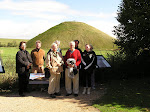
Last weekend we were supposed to be attending the opening of the new Buddha Grove at Albany Prison, but the governor cancelled at only a few days' notice on the feeble grounds that the plinth for the Buddha Rupa wasn't ready. As we had booked the hotel and the ferry and had arranged to stop off at a meeting of the Bahraini community being held in Portsmouth, we decided to go ahead. After a useful discussion with the Bahrainis including several old friends, we crossed on the 13.00 ferry and checked in at the elaborately 19th century Villa Rothsay, which had been used by King Edward VII when he was Prince of Wales during his visits to the island. He was Duke of Rothsay so the house was named after him.
In the afternoon we visited Osborne [www.english-heritage.org.uk/server.php?show=nav.14479], Queen Victoria's pad on the island where she enjoyed playing the housewife, free of any public commitments.
Monday we did Carisbrooke Castle [en.wikipedia.org/wiki/Carisbrooke_Castle] where Charles 1 was imprisoned for 14 months before being taken to London for his trial and execution. Then Quarr Abbey [www.quarrabbey.co.uk] where as it happened we attended the first half of vespers. Bhante had stayed there 20 years ago when there were 30 monks compared with only nine there for the service. Probably not so many people have vocations nowadays, and they may have some difficulty keeping the place up with dwindling numbers in the next few years, though the grounds and buildings seemed in good condition. Then back on the 18.00 ferry.
Tuesday I had a morning meeting at the House with some 40 Bahrainis, and fielded a Question on Darfur.
Wednesday, fielded a Question by Raymond Hylton calling for an independent review of the decision to detain asylum seekers, then spoke to an amendment on the Criminal Justice and Immigration Bill on facilities for the treatment of young people with a dependency on or a propensity to misuse alcohol. The Government aren't proposing to allow any additional resources for the new treatment orders, once again demonstrating that they don't take alcohol seriously.
Thursday I fielded a Question on Zimbabwe, and spoke on two Orders dealing with the early release of foreign national prisoners who are being removed or deported. On the TV news this evening it was announced that the previous early release scheme had allowed a couple of convicted terrorists to be released early, and Jack Straw had said he was going to see that this didn't happen again. As in the days of Henry VIII with his Statute of Proclamations, it seems that laws are now being made by decree, except that Mr Straw is mow the monarch.
Today I have been trying to clear backlogs of paperwork, though sidetracked by a case reported by the Kent Police to which Nick Tolson of Churchwatch drew my attention:
Arrests made at Canterbury Cathedral
Protesters attempt to disrupt service
Police arrested two men at Canterbury Cathedral on Sunday 23 March after they attempted to protest during the Archbishop of Canterbury's Easter Sunday service.
Their protests centred around the Archbishop's recent comments on Sharia law.
Kyle Spotswood, 26, of Dagenham Road, Sheffield and Sidney Cordle, 52, of Knowle Lane, Sheffield, were later charged with a disturbance in church under the 1860 Ecclesiastical Courts Jurisdiction Act. The offence under the Act carries a maximum penalty of two years imprisonment.
They have been bailed on condition they do not come into Kent except for their appearance at Canterbury Magistrates Court on 7 April.
Posted on: Updated Monday 24 March
Having attempted twice to repeal S 2 of the 1860 Ecclesiastical Courts Jurisdiction Act, and spent a year in the Select Committe on Religious Offences [www.parliament.the-stationery-office.co.uk/pa/ld200203/ldselect/
ldrelof/95/9501.htm], I have more than a passing interest in this case, and spent a couple of hours making telephone calls to find out whey the police (or the Crowm Prosecution Servive?) didn't think to use S 4A or S 5 of the Public Order Act 1986. It appears that the police didn't consult the CPS, as perhaps they would have needed to with such a small maximum penalty. But if they were under the impression that the offence carried a two year prison sentence, they certainly ought to have done so. If one of the objects is to deprive the protesters of the oxygen of publicity, its certainly a mistake to prosecute under the ECJA, because the use of this archaic legislation is bound to attract extra media attention.
Friday, March 28, 2008

Saturday, March 22, 2008
End of Mar's visit
She is off to the refugee camps in Thailand for Burmese fleeing the atrocious SPDC regime, then back to Canberra. She's been a lovely guest and we will miss her.


Thursday, March 20, 2008
Week in Westminster
Last Friday Phil Clarke came to see me about the research we have been conducting for several years on the statistical discrepancies in the various estimates of the number of refugees from Rwanda in the DRC at the end of 1996.. The Ministry of Defence had agreed to make available some large high resolution photographs taken from overflights of eastern Zaire (as it was then) by an RAF Canberra at the end of November 1996. More of this anon.
Monday I asked a supplementary on Lord Skelmersdales question on National Insurance numbers, which give a rough picture of the numbers entering the workforce. Only 3% of these people claim outof work benefits within six months, indication that the large majority of them are making a productive contribution to the economy.
Tuesday, to the West Ham football ground to speak at a conference of Traveller teachers in the morning, then back to Westminster for Roger Roberts' question on gay asylum seekers from Iran. Under pressure, the Government have agreed to give Mehdi Kazemi a new hearing. The Minister who was answering, Alan West, wasn't very well briefed, we thought.
Today I had a question on the situation in Tibet, and spoke later in Norman Fowler's debate on Iranian refugees and displaced people - four and a half million of them, who lost their homes because of the egregious folly of the invasion five years ago today.
Now we have Good Friday and Easter Monday off,with a dreadful weather forecast for the Easter weekend.
Monday I asked a supplementary on Lord Skelmersdales question on National Insurance numbers, which give a rough picture of the numbers entering the workforce. Only 3% of these people claim outof work benefits within six months, indication that the large majority of them are making a productive contribution to the economy.
Tuesday, to the West Ham football ground to speak at a conference of Traveller teachers in the morning, then back to Westminster for Roger Roberts' question on gay asylum seekers from Iran. Under pressure, the Government have agreed to give Mehdi Kazemi a new hearing. The Minister who was answering, Alan West, wasn't very well briefed, we thought.
Today I had a question on the situation in Tibet, and spoke later in Norman Fowler's debate on Iranian refugees and displaced people - four and a half million of them, who lost their homes because of the egregious folly of the invasion five years ago today.
Now we have Good Friday and Easter Monday off,with a dreadful weather forecast for the Easter weekend.
TLRU meeting March 7
Meeting of the Traveller Law Research Unit Adisory Group meeting, with Elena Tsetsekou, Administrator, Migration and Roma Department, Social Cohesion Directorate, Council of Europe. The CoE has worked on an awareness campaign, but although most member states have official policies on equality, the majority of populations are slow to understand the need. Cases heard at the European Court of Human Rights have made a bigger difference than national policies.

Friday, March 14, 2008
Orpington Circle Inauguration Dinner
Yesterday evening, as guests of Paul Hunt, Chairman of the National Liberal Club, at a dinner to launch the Orpington Circle, an organisation of Club members to support Liberal Democrat candidates at by-elections. First picture is Gill Pratt (nee Cheesbrough) who was my right hand in the Commons from 1964 to 1966. She married and moved to Huddersfield and I hadn't seen her for over 40 years. Second picture is of Chris Maines, LibDem candidate for Orpington 5 times, who only missed by 269 votes in 2001; and on my right, David McBride, the present candidate.


Tuesday, March 11, 2008
Update
The busier I am, the later my posts, but here's a belated update on March so far.
Monday March 3 presented the awards to Gypsy and Traveller children winners of the ELAMP distance learning awards, in the Moses Room of the House of Lords. Its a great scheme for GRT children who travel in the summer to receive assignments and send in their coursework using laptops.
Then my Question on the UNICEF report on The State of the World's Children 2008, with particular reference to the lack of progress in reducing infant and maternal mortality in West Africa.
At 16.00, weekly meeting of the Select Committee considering the value for money we get from our subscriptions to international organisations concerned with communicable diseases, mainly B, malaria and HIV/AIDS. So fare we have been considering evidence from medical and academic bodies.
At 18.15, meeting with (Baroness) Kay Andrews to discuss my amendment to the Criminal Justice & Immigration Bill abolishing blasphemy and the remaining statutory religious offences, dealt with by the Law Commission in 1985 and covered by my Bills of 1995 and 2002, followed by the Select Committee on Religious Offences which reported in 2003. The Government had tabled their owm amendment falling a bit short of mine, in that they retained a couple of obsolete Acts I wanted to repeal. The main one was the Ecclesiastical Courts Jurisdiction Act 1860, which provides that
"riotous, violent, or indecent behaviour in England or Ireland in any cathedral church, parish or district church or chapel of the Church of England, or in any chapel of any religious denomination, or in England in any places of religious worship duly certified under the provisions of the Places of Worship Registration Act 1855, whether during the celebration of divine service or at any other time, or in any churchyard or burial ground, or who shall molest, let, disturb, vex, or trouble, or by any other unlawful means disquiet or misuse any preacher duly authorized to preach therein, or any clergyman in holy orders ministering or celebrating any sacrament, or any divine service, rite, or office, in any cathedral, church, or chapel, or in any churchyard or burial ground, shall, on conviction thereof before two justices of the peace, be liable to a penalty of not more than [F4 level 1 on the standard scale]for every such offence, or may, if the justices before whom he shall be convicted think fit, instead of being subjected to any pecuniary penalty, be committed to prison for any time not exceeding two months".
My argument is that the charge is rarely used, and that conduct of the kind described can be dealt with by the secular laws dealing with public order or harassment. Kay wouldn't have been in a position to make a concession even if she had agreed with me, because Ministers in the Lords are kept on a short leash by their Departments
Tuesday, met TH< who was unfairly sacked by the UNHCR and offered inadequate compensation by the UN Appeals Tribunal many years later. Lord Desai and I are advising him on further steps to get a fair deal.
Then a meeting with Akin Birdal, Turkey's most prominent human rights activists, who has been imprisoned, shot by attempted assassins, but still keeps going.
Wednesday, the debate on the floor of the House on the religious offences amendments. Having got three quarters of a loaf,I will have a go at getting the remaining slices at the Report Stage. In the dinner hour, took part in a debate on the National Audit Office report on risks to overseas territories. I spoke about tax avoidance, the shabby treatment of the Chagos Islanders who were expelled from their lands, and the reversal of moves towards self-government on Ascension Island. All in six minutes. The dinner hour debates are timed, and the more speakers there are, the shorter each speaker has to be.
Thursday, a meeting with Mark Canning, our Ambassador to Burma. At Question time, joined in Lindsay Northover's question on gender inequality, and in Lord de Mauley's, on alcohol and young people.
Yesterday, Monday March 10, lunch and discussion with Abbas al-Bayati, Iraqi MP and Turcoman leader who is on the Committee looking at constitutional change. The Turcomans are concerned among other matters with the status of Kirkuk. Because all decisions have to be unanimous, no progress is being made.
Later, joined in Baroness Rawlings' Question onclimate change and South West Africa, then in the Criminal Justice and Immigration Bill, moved amendments deleting Part 12, dealing with 'Special Immigration Status'. The Government want to create a limbo for people they say are disqualified from refugee status but can't be deported for human rights reasons. The UNHCR say the Government are wrongly interpreting the Convention.to make these ew people destitute for as long as they remain in the UK.
This special status is being created because the convictions of the hijackers who brought a plane load of asylum seekers here from Afghanistan in 2000 were quahed by the Court of Appeal,and they would have had to grant the hijackers 6 months renewable leave to remain without these provisions. We say that nobody was killed or injured by the hijackers, but 100 people were delivered from torture or execution by the Taliban, who ruled the country at the time.
Today, spent the morning and spoke at the National Association of Traveller Teachers/ Advisory Council on theEducation of Romanies and Travellers conference in West Ham. Returned to Westminster in time to join in a Question on the threatened deportation of an Iranian homosexual,Mehdi Kazemi. I asked whether,in view of the persecution of gay and lesbian people in Iran, they would promote an EU wide moratorium on the deportation of gay and lesbian people to Iran.
Later, sat in on Climate Change Bill and spoke on two amendments.
Monday March 3 presented the awards to Gypsy and Traveller children winners of the ELAMP distance learning awards, in the Moses Room of the House of Lords. Its a great scheme for GRT children who travel in the summer to receive assignments and send in their coursework using laptops.
Then my Question on the UNICEF report on The State of the World's Children 2008, with particular reference to the lack of progress in reducing infant and maternal mortality in West Africa.
At 16.00, weekly meeting of the Select Committee considering the value for money we get from our subscriptions to international organisations concerned with communicable diseases, mainly B, malaria and HIV/AIDS. So fare we have been considering evidence from medical and academic bodies.
At 18.15, meeting with (Baroness) Kay Andrews to discuss my amendment to the Criminal Justice & Immigration Bill abolishing blasphemy and the remaining statutory religious offences, dealt with by the Law Commission in 1985 and covered by my Bills of 1995 and 2002, followed by the Select Committee on Religious Offences which reported in 2003. The Government had tabled their owm amendment falling a bit short of mine, in that they retained a couple of obsolete Acts I wanted to repeal. The main one was the Ecclesiastical Courts Jurisdiction Act 1860, which provides that
"riotous, violent, or indecent behaviour in England or Ireland in any cathedral church, parish or district church or chapel of the Church of England, or in any chapel of any religious denomination, or in England in any places of religious worship duly certified under the provisions of the Places of Worship Registration Act 1855, whether during the celebration of divine service or at any other time, or in any churchyard or burial ground, or who shall molest, let, disturb, vex, or trouble, or by any other unlawful means disquiet or misuse any preacher duly authorized to preach therein, or any clergyman in holy orders ministering or celebrating any sacrament, or any divine service, rite, or office, in any cathedral, church, or chapel, or in any churchyard or burial ground, shall, on conviction thereof before two justices of the peace, be liable to a penalty of not more than [F4 level 1 on the standard scale]for every such offence, or may, if the justices before whom he shall be convicted think fit, instead of being subjected to any pecuniary penalty, be committed to prison for any time not exceeding two months".
My argument is that the charge is rarely used, and that conduct of the kind described can be dealt with by the secular laws dealing with public order or harassment. Kay wouldn't have been in a position to make a concession even if she had agreed with me, because Ministers in the Lords are kept on a short leash by their Departments
Tuesday, met TH< who was unfairly sacked by the UNHCR and offered inadequate compensation by the UN Appeals Tribunal many years later. Lord Desai and I are advising him on further steps to get a fair deal.
Then a meeting with Akin Birdal, Turkey's most prominent human rights activists, who has been imprisoned, shot by attempted assassins, but still keeps going.
Wednesday, the debate on the floor of the House on the religious offences amendments. Having got three quarters of a loaf,I will have a go at getting the remaining slices at the Report Stage. In the dinner hour, took part in a debate on the National Audit Office report on risks to overseas territories. I spoke about tax avoidance, the shabby treatment of the Chagos Islanders who were expelled from their lands, and the reversal of moves towards self-government on Ascension Island. All in six minutes. The dinner hour debates are timed, and the more speakers there are, the shorter each speaker has to be.
Thursday, a meeting with Mark Canning, our Ambassador to Burma. At Question time, joined in Lindsay Northover's question on gender inequality, and in Lord de Mauley's, on alcohol and young people.
Yesterday, Monday March 10, lunch and discussion with Abbas al-Bayati, Iraqi MP and Turcoman leader who is on the Committee looking at constitutional change. The Turcomans are concerned among other matters with the status of Kirkuk. Because all decisions have to be unanimous, no progress is being made.
Later, joined in Baroness Rawlings' Question onclimate change and South West Africa, then in the Criminal Justice and Immigration Bill, moved amendments deleting Part 12, dealing with 'Special Immigration Status'. The Government want to create a limbo for people they say are disqualified from refugee status but can't be deported for human rights reasons. The UNHCR say the Government are wrongly interpreting the Convention.to make these ew people destitute for as long as they remain in the UK.
This special status is being created because the convictions of the hijackers who brought a plane load of asylum seekers here from Afghanistan in 2000 were quahed by the Court of Appeal,and they would have had to grant the hijackers 6 months renewable leave to remain without these provisions. We say that nobody was killed or injured by the hijackers, but 100 people were delivered from torture or execution by the Taliban, who ruled the country at the time.
Today, spent the morning and spoke at the National Association of Traveller Teachers/ Advisory Council on theEducation of Romanies and Travellers conference in West Ham. Returned to Westminster in time to join in a Question on the threatened deportation of an Iranian homosexual,Mehdi Kazemi. I asked whether,in view of the persecution of gay and lesbian people in Iran, they would promote an EU wide moratorium on the deportation of gay and lesbian people to Iran.
Later, sat in on Climate Change Bill and spoke on two amendments.
Sunday, March 02, 2008

Thursday, February 28, 2008
The week
I should have added, in the note on the Second Reading of my House of Lords (Amendment) Bill last Friday, that the Leader of the Conservatives, Lord Strathclyde, called me 'shallow and discraceful'. I thanked him for his compliments, which will do me good with my Party.
Monday from 10.00 to 13.00 I chaired a very successful and well-atttended seminar on Bangladesh in the Moses Room, with speakers from the Commons, the European Parliament, the Bangladesh High Commission, Amnesty International, Human Rights Watch, the Awami League, the BNP etc. We were looking at the roadmap to the elections, which are to be held by the end of the year. In April there are to be local elections in the larger towns and cities, and the High Commissioner said that the ID cards would be issued to al the urban electors, and the registers would be published in good time. Although the timetable has slipped, the authorities will consider publishing a revised paper on the tasks that remain to be completed before the general election. The Electoral Commission has recommended that the restrictions on political activites should be lifted on March 20, and they are in fact being progessively relaxed. There are still concerns about the treatment of some independent TV stations and some print journalists, and we are intending to summarise these and other matters raised during the seminar in a communication to Dhaka, via the High Commissioner.
Monday afternoon from 16.00 to 18.00 I had Select Committee on International Organisations, which is considering whether the UK gets value for money from its payments to the World Health Organisation etc, in tackling communicable diseases - mainly HIV/AIDS, TB and Malaria, the three largest killers (though I hope we will pay some attention o pneumococcal disease, which kills a million children a year). We are also looking at the organisations that are preparing for the next flu pandemic,a matter of when, not whether. The Committee took evidence on Monday from the Health Protection Agency, which has an important role to play in protecting our own population against communicable diseases as well as other potential hazards such as chemical and nuclear, by providing impartial advice and authoritative information on health protection issues to the public, communities, professionals and to government.
Then from 19.30 to 20.30 I was in the Chamber speaking on two Orders - one on the above-cost fees to be charged for certain immigration services, the other on the vast database to be constructed giving details of the passports and 'Pasnger Name Records' of every person entering or leaving the United Kingdom, at a cost of £1.4 billion. Of this, £240 million is to be charged to airlines.After the debate I had a call from the Geneva-based SITA, the world's leading service provider of IT business solutions and communication services to the air transport industry, who are coming to see me to discuss problems arising from this proposal. Somebody reads Hansard!
Tuesday I hosted an English Speaking Union tea party as understudy for my colleague George Thomson (Lord Thomson of Monifieth), who wasn't well. George is 86 and pretty good for his age, but I think he's had some knee problems recently.
Then I had a meeting with Hugh McKinney and Nick Osbourne to discuss the work of the Al-Party Group on Pneumococcal Disease, and particularly the outline of a report by the Group.
In the dinner hour debate I spoke on the human rights situation in West Papua. The UN Rapporteur on Human Rights Defenders, Hina Jilani, was there last summe, and as well as her report, there is a good deal of material from the US State Department, Human Rights Watch and Amnesty International. The Indonesians had also invited Manfred Nowak, the Rapporteur on Torture, to visit West Papua, and openness to the UN Special Procedures is a move in the right direction, though journalists and human rights NGOs are still not welcome in the Province.
Wednesday, Party meeting 14.00 to 15.00. Then I fielded a question on the return to war in Sri Lanka, and the recommendations of the All-Party Representative Committee there. I asked what DfID was contributing towards the Common Humanitarian Action Plan, which it is feared may have to assist half a million people; whether the Ministr agreed that limited devolution of power to the north and east would do something to mitigate the polarisation of the two communities, even though it would be better to insist that the all-party committee recommendations are published by April, even if the parties weren't unanimous, and if the Minister would comment on the need for a more politically powerful contact group, now that the Norwegian role has come to an end.
After questions I attended a meeting of the Parliamentary Human Rights Group officers - I'm Vice-Chair - with the Russian Ambassador, largely to discuss the situation in Chechnya. He agreed that the Group could send a delegation to Chechnya.
Today I fielded a question on the queues at immigration control at the UK's airports. The evidence is that the length of the queues vary, from 0 to 68 minutes, and there must be best practice that could be developed from an analysis of the reasons for the differences between one airport and another.
After lunch I was invited to te office of the Leader of the House, Cathy Ashton (Baroness Ashton of Upholland) who was receiving a large party of schoolchildren She had promised to get me the answer to a question I had tabled more than three and a half months ago, on the dates of the former Prime Minister Tony Blair's contacts with Rupert Murdoch towards the end of his term of office. The schoolchildren left; the answer to the question arrived hot off the press, and Cathy handed it to me!
Monday from 10.00 to 13.00 I chaired a very successful and well-atttended seminar on Bangladesh in the Moses Room, with speakers from the Commons, the European Parliament, the Bangladesh High Commission, Amnesty International, Human Rights Watch, the Awami League, the BNP etc. We were looking at the roadmap to the elections, which are to be held by the end of the year. In April there are to be local elections in the larger towns and cities, and the High Commissioner said that the ID cards would be issued to al the urban electors, and the registers would be published in good time. Although the timetable has slipped, the authorities will consider publishing a revised paper on the tasks that remain to be completed before the general election. The Electoral Commission has recommended that the restrictions on political activites should be lifted on March 20, and they are in fact being progessively relaxed. There are still concerns about the treatment of some independent TV stations and some print journalists, and we are intending to summarise these and other matters raised during the seminar in a communication to Dhaka, via the High Commissioner.
Monday afternoon from 16.00 to 18.00 I had Select Committee on International Organisations, which is considering whether the UK gets value for money from its payments to the World Health Organisation etc, in tackling communicable diseases - mainly HIV/AIDS, TB and Malaria, the three largest killers (though I hope we will pay some attention o pneumococcal disease, which kills a million children a year). We are also looking at the organisations that are preparing for the next flu pandemic,a matter of when, not whether. The Committee took evidence on Monday from the Health Protection Agency, which has an important role to play in protecting our own population against communicable diseases as well as other potential hazards such as chemical and nuclear, by providing impartial advice and authoritative information on health protection issues to the public, communities, professionals and to government.
Then from 19.30 to 20.30 I was in the Chamber speaking on two Orders - one on the above-cost fees to be charged for certain immigration services, the other on the vast database to be constructed giving details of the passports and 'Pasnger Name Records' of every person entering or leaving the United Kingdom, at a cost of £1.4 billion. Of this, £240 million is to be charged to airlines.After the debate I had a call from the Geneva-based SITA, the world's leading service provider of IT business solutions and communication services to the air transport industry, who are coming to see me to discuss problems arising from this proposal. Somebody reads Hansard!
Tuesday I hosted an English Speaking Union tea party as understudy for my colleague George Thomson (Lord Thomson of Monifieth), who wasn't well. George is 86 and pretty good for his age, but I think he's had some knee problems recently.
Then I had a meeting with Hugh McKinney and Nick Osbourne to discuss the work of the Al-Party Group on Pneumococcal Disease, and particularly the outline of a report by the Group.
In the dinner hour debate I spoke on the human rights situation in West Papua. The UN Rapporteur on Human Rights Defenders, Hina Jilani, was there last summe, and as well as her report, there is a good deal of material from the US State Department, Human Rights Watch and Amnesty International. The Indonesians had also invited Manfred Nowak, the Rapporteur on Torture, to visit West Papua, and openness to the UN Special Procedures is a move in the right direction, though journalists and human rights NGOs are still not welcome in the Province.
Wednesday, Party meeting 14.00 to 15.00. Then I fielded a question on the return to war in Sri Lanka, and the recommendations of the All-Party Representative Committee there. I asked what DfID was contributing towards the Common Humanitarian Action Plan, which it is feared may have to assist half a million people; whether the Ministr agreed that limited devolution of power to the north and east would do something to mitigate the polarisation of the two communities, even though it would be better to insist that the all-party committee recommendations are published by April, even if the parties weren't unanimous, and if the Minister would comment on the need for a more politically powerful contact group, now that the Norwegian role has come to an end.
After questions I attended a meeting of the Parliamentary Human Rights Group officers - I'm Vice-Chair - with the Russian Ambassador, largely to discuss the situation in Chechnya. He agreed that the Group could send a delegation to Chechnya.
Today I fielded a question on the queues at immigration control at the UK's airports. The evidence is that the length of the queues vary, from 0 to 68 minutes, and there must be best practice that could be developed from an analysis of the reasons for the differences between one airport and another.
After lunch I was invited to te office of the Leader of the House, Cathy Ashton (Baroness Ashton of Upholland) who was receiving a large party of schoolchildren She had promised to get me the answer to a question I had tabled more than three and a half months ago, on the dates of the former Prime Minister Tony Blair's contacts with Rupert Murdoch towards the end of his term of office. The schoolchildren left; the answer to the question arrived hot off the press, and Cathy handed it to me!
Wednesday, February 27, 2008

Tuesday, February 26, 2008
Daily Star, Dhaka
Daily Star
Bangladesh reminded of obligation to hold free, fair election
UNB, London
British and European parliamentarians have said the Bangladesh caretaker government should live up to its political obligation by lifting the state of emergency so as to allow political activities and political reform.
As "friends of fair and democratic Bangladesh", they have reminded the government of its obligation to hold free and fair elections.
The observations were made at a seminar on "The Roadmap to Parliamentary Elections?" held yesterday in the Moses Room at the Houses of Lords.
The seminar was organised by the International Bangladesh Foundation and chaired by Lord Avebury, vice chair of All Party Parliamentary Human Rights Group and chairman of International Bangladesh Foundation.
It was attended by MPs, MEPs, peers, councillors and representatives of human rights organisations, including Amnesty International, Human Rights Watch, Global Human Rights Defence, Jumma People's Network, Nirmul Committee and Bangladesh Hindu Buddhist Christian Unity Council.
The speakers at the seminar said human rights violations and lifting of the emergency rule must be placed on the reform agenda as a top priority and the government must respect human rights of its citizens and ensure that no torture takes place.
Lord Avebury in his opening remarks said, "We're concentrating on the conditions that will enable free and fair elections to be held as scheduled before the end of the year."
He reminded that according to the electoral roadmap, talks with political parties were to be completed by the end of 2007, and electoral reforms to be passed by March. "These targets have slipped," he said.
Saida Muna Tasneem, counsellor at Bangladesh High Commission in London, gave a presentation on and an overview of the caretaker government's commitment to the roadmap to parliamentary elections by December 2008.
She informed the seminar of the progress in voter registration work and various reforms the government has already implemented, including separation of the judiciary and formation of independent Election Commission, Anti-Corruption Commission and National Human Rights Commission.
Tasneem called for continued support from the international partners for successful completion of the caretaker government's roadmap and reforms.
Baroness Pola Uddin, chair of Britain-Bangladesh All Party Parliamentary Group; Anne Main MP, chair of Conservative Friends of Bangladesh; Jeremy Corbyn MP of Britain-Bangladesh All-Party Parliamentary Group; Robert Evans MEP, chair of European Parliament's South Asia Delegation; Dr Charles Tannock MEP, vice president of subcommittee of European Parliament's Human Rights; Tim Parritt, deputy programme director for Asia of Amnesty International; Brad Adams, Asia director for Human Rights Watch; and Sultan Shariff of the Awami League also spoke at the seminar.
Joshna Miah of BNP, MA Rauf of Gano Forum, and Dr Ahmed Ziauddin, Bangladesh Centre for Genocide Studies, Belgium, and Sally Kebble MP also attended the seminar.
In the general discussion that followed, speakers expressed their "deep concern over the human rights abuses" under the state of emergency in the country. Some speakers raised the issue of the trial of war criminals.
The speakers, however, appreciated the various steps taken by the present government against corruption, terrorism and welcomed Chief Adviser Fakhruddin Ahmed's recent comments against the war criminals but stated that it is the duty of the government to initiate cases and take initiatives against the alleged war criminals.
Lord Avebury in his concluding remarks said, "There has to be freedom of expression and of assembly if elections are to be free and fair."
He added: "Elections aren't only about having the right laws, an accurate register and impartial officials. They depend on the preconditions in the months before polling day, and crucially, on the maintenance of a peaceful environment during election campaign."
Bangladesh reminded of obligation to hold free, fair election
UNB, London
British and European parliamentarians have said the Bangladesh caretaker government should live up to its political obligation by lifting the state of emergency so as to allow political activities and political reform.
As "friends of fair and democratic Bangladesh", they have reminded the government of its obligation to hold free and fair elections.
The observations were made at a seminar on "The Roadmap to Parliamentary Elections?" held yesterday in the Moses Room at the Houses of Lords.
The seminar was organised by the International Bangladesh Foundation and chaired by Lord Avebury, vice chair of All Party Parliamentary Human Rights Group and chairman of International Bangladesh Foundation.
It was attended by MPs, MEPs, peers, councillors and representatives of human rights organisations, including Amnesty International, Human Rights Watch, Global Human Rights Defence, Jumma People's Network, Nirmul Committee and Bangladesh Hindu Buddhist Christian Unity Council.
The speakers at the seminar said human rights violations and lifting of the emergency rule must be placed on the reform agenda as a top priority and the government must respect human rights of its citizens and ensure that no torture takes place.
Lord Avebury in his opening remarks said, "We're concentrating on the conditions that will enable free and fair elections to be held as scheduled before the end of the year."
He reminded that according to the electoral roadmap, talks with political parties were to be completed by the end of 2007, and electoral reforms to be passed by March. "These targets have slipped," he said.
Saida Muna Tasneem, counsellor at Bangladesh High Commission in London, gave a presentation on and an overview of the caretaker government's commitment to the roadmap to parliamentary elections by December 2008.
She informed the seminar of the progress in voter registration work and various reforms the government has already implemented, including separation of the judiciary and formation of independent Election Commission, Anti-Corruption Commission and National Human Rights Commission.
Tasneem called for continued support from the international partners for successful completion of the caretaker government's roadmap and reforms.
Baroness Pola Uddin, chair of Britain-Bangladesh All Party Parliamentary Group; Anne Main MP, chair of Conservative Friends of Bangladesh; Jeremy Corbyn MP of Britain-Bangladesh All-Party Parliamentary Group; Robert Evans MEP, chair of European Parliament's South Asia Delegation; Dr Charles Tannock MEP, vice president of subcommittee of European Parliament's Human Rights; Tim Parritt, deputy programme director for Asia of Amnesty International; Brad Adams, Asia director for Human Rights Watch; and Sultan Shariff of the Awami League also spoke at the seminar.
Joshna Miah of BNP, MA Rauf of Gano Forum, and Dr Ahmed Ziauddin, Bangladesh Centre for Genocide Studies, Belgium, and Sally Kebble MP also attended the seminar.
In the general discussion that followed, speakers expressed their "deep concern over the human rights abuses" under the state of emergency in the country. Some speakers raised the issue of the trial of war criminals.
The speakers, however, appreciated the various steps taken by the present government against corruption, terrorism and welcomed Chief Adviser Fakhruddin Ahmed's recent comments against the war criminals but stated that it is the duty of the government to initiate cases and take initiatives against the alleged war criminals.
Lord Avebury in his concluding remarks said, "There has to be freedom of expression and of assembly if elections are to be free and fair."
He added: "Elections aren't only about having the right laws, an accurate register and impartial officials. They depend on the preconditions in the months before polling day, and crucially, on the maintenance of a peaceful environment during election campaign."
Monday, February 25, 2008

Friday, February 22, 2008
Hereditary by-elections
Second reading of my House of Lords (Amendment) Bill this morning. The Tories say that the scheme for maintaining the number of hereditaries at 92, which was cobbled together by Jack Weatherill in 1999, was binding in honour on the two main parties' front benches, and thus on the House as a whole. But there is a well-established principle that Parliament can't bind its successors, and back-benchers of all Parties, who weren't part of the backstairs deal, have no obligation to stick to it. Not a single one of the speakers defended the by-elections on objective grounds

Thursday, February 21, 2008

Update
First posting in February!
In the Houise:
February 6 question on Kenya, debate on Zimbabwe
February 7 question on floods in southern Africa
February 18 chaired Maqbool Butt memorial event, spoke on Infant Formula
February 20 statement on citizenship
February 21 question on Darfur
During the week's February recess, spent four days in Pakistan talking to journalists, lawyers and others about the legal crisis, with 50 judges sacked, 3 judges of the Supreme Court in incommunicado detention. Most were pessimistic about the likelihood of change after the February 18 Parliamentary elections, but they were reasonably fair, and there is some hope now that the rule of law will be restored.
Tomorrow I have the second reading of my House of Lords (Amendment) Bill, to abolish the by-elections to maintain the 92 hereditary peers. But with the emergency legislation on Northern Rock there's a danger that Friday's sitting will be cancelled.
In the Houise:
February 6 question on Kenya, debate on Zimbabwe
February 7 question on floods in southern Africa
February 18 chaired Maqbool Butt memorial event, spoke on Infant Formula
February 20 statement on citizenship
February 21 question on Darfur
During the week's February recess, spent four days in Pakistan talking to journalists, lawyers and others about the legal crisis, with 50 judges sacked, 3 judges of the Supreme Court in incommunicado detention. Most were pessimistic about the likelihood of change after the February 18 Parliamentary elections, but they were reasonably fair, and there is some hope now that the rule of law will be restored.
Tomorrow I have the second reading of my House of Lords (Amendment) Bill, to abolish the by-elections to maintain the 92 hereditary peers. But with the emergency legislation on Northern Rock there's a danger that Friday's sitting will be cancelled.
Subscribe to:
Posts (Atom)