
Sunday, October 29, 2006

Saturday, October 28, 2006

David Ramsbotham's debate on SLT and young offenders
27 Oct 2006 : Column 1451
2.35 pm
Lord Avebury: My Lords, when the chairman of the Youth Justice Board, Rob Morgan, the Chief Inspector of Prisons, Anne Owers, and the Children’s Commissioner for England, Professor Al Ainsley-Green, visited Feltham Young Offender Institution last Tuesday, they jointly called for an honest debate about alternative ways of dealing with young offenders who commit low-level and less serious crime. They said that more than 3,350 children and young people are being held in custody today. The youth justice system has just a handful of bed spaces left. We simply cannot put up a sign saying “No Vacancies”. Action is urgently needed to stop custody for young people going into meltdown.
As with adults, but even more so with children, the courts ought to consider whether, by awarding custodial sentences, they may be increasing criminality by exposing vulnerable people to bad influences, particularly when they know that the places to which these offenders are sent are bursting at the seams. They also know that in those circumstances it becomes increasingly difficult for prison and YOI governors and staff to give adequate attention to those who get into trouble because they are suffering from a range of mental health, substance abuse and communications problems and disabilities.
In the case of speech, language and communication, they have not even got as far as systematically assessing the problem, six years after it was highlighted by the noble Lord, Lord Ramsbotham, when, as Chief Inspector of Prisons, as he described, he visited HM YOI Swinfen Hall in November 2000. He told your Lordships how he brought in Professor Karen Bryan of the University of Surrey to assist him, and her survey revealed alarming rates of disability in speech, language and communications among the young offenders in every test that was applied. The noble Lord—the Chief Inspector, as he was then—recommended that further research should be conducted to establish the extent of these problems more generally and their impact on prison careers and re-offending.
It stood to reason that prisoners with those impairments were more likely to leave prison with unresolved problems that could lead to re-offending. Professor Bryan suggested—and the noble Lord endorsed this—that appropriate screening should be developed, validated and included with educational entry tests throughout the prison system. The noble Lord then commended Dr Bryan’s analysis to the Director-General, and said that the DfES needed to think about remedial education for these disadvantaged young men.
In a debate on prisons in July the following year I asked whether the matter was being pursued. As the noble Lord, Lord Rooker, did not make any comment in his winding-up speech, I wrote to him the following day asking him about taking the recommendations further. Beverley Hughes MP, who was then Minister for Prisons, replied that there was no standard approach to screening for these impairments, but that Professor Bryan’s findings had been incorporated in something she called “the health needs assessment toolkit”. A principal education officer had been
27 Oct 2006 : Column 1452
appointed to survey education and training at YOIs with a remit to look at learning disabilities.
Four years on from the original recommendations, however, the noble Baroness, Lady Scotland, told me on 12 January 2005 that they had still to study Professor Bryan’s report, and would then consider any action that might be appropriate. The noble Lord, Lord Ramsbotham, and I had both tried to prompt the noble Lord, Lord Warner, in Questions on 27 March, but he then wrote to say that there was no money in the Prison Service health budget up to 2003 for speech and language posts, and that since then it was entirely a matter for PCTs, as the noble Lord, Lord Ramsbotham, has explained, to decide how the available money should be spent. There were no plans to fund these posts centrally.
As the noble Lord also explained, no provision had been made to replace the speech therapy funding provided by the Helen Hamlyn Trust, which ceased in July 2005. I wrote again to the noble Baroness, Lady Scotland, saying that we seemed to be back to square one, with every PCT deciding its own policy on speech and language problems, in spite of the evidence of the prevalence of these difficulties and the bearing they were likely to have on the propensity to reoffend. The noble Baroness replied that no screening was undertaken of young offenders for speech and communication difficulties per se, but that the Government preferred a general learning needs assessment to identify all learning difficulties or disabilities. This process, a key part of the learning and skills delivery arrangements for all offenders, would lead to referrals to appropriate health or education professionals.
I wrote again to the noble Baroness on 18 June asking her how, as part of the general assessment, speech and language difficulties would be assessed and by whom—bearing in mind that there was no funding for those posts, as the noble Lord explained—and how, if PCTs were unwilling to fund SLT services, as we heard, they would be provided for offenders identified by the general screening as needing them. I also sent her an account of research by David Moseley et al on behalf of the Learning and Skills Development Agency—mentioned by the noble Lord, Lord Ramsbotham—which showed that training in oral communication for prisoners in general cut reconviction rates within the first year after release from 44 per cent to 21 per cent. It is surely reasonable to suppose that for inmates with speech and language difficulties the benefits could be even more spectacular.
As the noble Lord said, unfortunately, while PCTs have to pay for SLT as part of health services, in the current climate of cuts and reorganisation it is bound to have a low priority. Werrington now has a part-time speech and language therapist and at Brinsford the local PCT has carried out a needs analysis but as yet they have no service. Managers are making out a business case for SLT in their local YOI, but I am not aware of any instances where this process has led to the delivery of a service. Why, in any case, should it be necessary to reinvent the wheel in each of the 15 PCTs which serve the 11 male and
27 Oct 2006 : Column 1453
four female YOIs? If there is an overwhelming case—there is no doubt that the noble Lord, Lord Ramsbotham, made out such a case—it applies throughout the estate and management effort ought not to be spent on proving it 15 times over.
I simply do not understand why the Home Office, which, one would think, must be desperate to find effective ways of lowering reconviction rates, has dithered and procrastinated for the past five years over an approach which would certainly produce immediate and possibly very substantial benefits to the prisoners concerned and to society as a whole. Up to 90 per cent of juvenile offenders have below-average language skills and two-thirds are below level 1 literacy. These young people do not have the skills to cope with verbal interventions aimed at reducing reoffending. Therefore, all juvenile offenders should be assessed, using known techniques, and remedial SLT provided for those who need it, using ring-fenced money, as the noble Lord, Lord Ramsbotham, demanded. It is partly because of the failure to apply the lessons of six years ago, and of the other work reinforcing the pioneering study by Professor Bryan and the noble Lord, Lord Ramsbotham, that our adult prisons are overflowing today.
{www.publications.parliament.uk/pa/ld199900/ldhansrd/pdvn/
lds06/text/61027-0002.htm#06102742000005]
2.35 pm
Lord Avebury: My Lords, when the chairman of the Youth Justice Board, Rob Morgan, the Chief Inspector of Prisons, Anne Owers, and the Children’s Commissioner for England, Professor Al Ainsley-Green, visited Feltham Young Offender Institution last Tuesday, they jointly called for an honest debate about alternative ways of dealing with young offenders who commit low-level and less serious crime. They said that more than 3,350 children and young people are being held in custody today. The youth justice system has just a handful of bed spaces left. We simply cannot put up a sign saying “No Vacancies”. Action is urgently needed to stop custody for young people going into meltdown.
As with adults, but even more so with children, the courts ought to consider whether, by awarding custodial sentences, they may be increasing criminality by exposing vulnerable people to bad influences, particularly when they know that the places to which these offenders are sent are bursting at the seams. They also know that in those circumstances it becomes increasingly difficult for prison and YOI governors and staff to give adequate attention to those who get into trouble because they are suffering from a range of mental health, substance abuse and communications problems and disabilities.
In the case of speech, language and communication, they have not even got as far as systematically assessing the problem, six years after it was highlighted by the noble Lord, Lord Ramsbotham, when, as Chief Inspector of Prisons, as he described, he visited HM YOI Swinfen Hall in November 2000. He told your Lordships how he brought in Professor Karen Bryan of the University of Surrey to assist him, and her survey revealed alarming rates of disability in speech, language and communications among the young offenders in every test that was applied. The noble Lord—the Chief Inspector, as he was then—recommended that further research should be conducted to establish the extent of these problems more generally and their impact on prison careers and re-offending.
It stood to reason that prisoners with those impairments were more likely to leave prison with unresolved problems that could lead to re-offending. Professor Bryan suggested—and the noble Lord endorsed this—that appropriate screening should be developed, validated and included with educational entry tests throughout the prison system. The noble Lord then commended Dr Bryan’s analysis to the Director-General, and said that the DfES needed to think about remedial education for these disadvantaged young men.
In a debate on prisons in July the following year I asked whether the matter was being pursued. As the noble Lord, Lord Rooker, did not make any comment in his winding-up speech, I wrote to him the following day asking him about taking the recommendations further. Beverley Hughes MP, who was then Minister for Prisons, replied that there was no standard approach to screening for these impairments, but that Professor Bryan’s findings had been incorporated in something she called “the health needs assessment toolkit”. A principal education officer had been
27 Oct 2006 : Column 1452
appointed to survey education and training at YOIs with a remit to look at learning disabilities.
Four years on from the original recommendations, however, the noble Baroness, Lady Scotland, told me on 12 January 2005 that they had still to study Professor Bryan’s report, and would then consider any action that might be appropriate. The noble Lord, Lord Ramsbotham, and I had both tried to prompt the noble Lord, Lord Warner, in Questions on 27 March, but he then wrote to say that there was no money in the Prison Service health budget up to 2003 for speech and language posts, and that since then it was entirely a matter for PCTs, as the noble Lord, Lord Ramsbotham, has explained, to decide how the available money should be spent. There were no plans to fund these posts centrally.
As the noble Lord also explained, no provision had been made to replace the speech therapy funding provided by the Helen Hamlyn Trust, which ceased in July 2005. I wrote again to the noble Baroness, Lady Scotland, saying that we seemed to be back to square one, with every PCT deciding its own policy on speech and language problems, in spite of the evidence of the prevalence of these difficulties and the bearing they were likely to have on the propensity to reoffend. The noble Baroness replied that no screening was undertaken of young offenders for speech and communication difficulties per se, but that the Government preferred a general learning needs assessment to identify all learning difficulties or disabilities. This process, a key part of the learning and skills delivery arrangements for all offenders, would lead to referrals to appropriate health or education professionals.
I wrote again to the noble Baroness on 18 June asking her how, as part of the general assessment, speech and language difficulties would be assessed and by whom—bearing in mind that there was no funding for those posts, as the noble Lord explained—and how, if PCTs were unwilling to fund SLT services, as we heard, they would be provided for offenders identified by the general screening as needing them. I also sent her an account of research by David Moseley et al on behalf of the Learning and Skills Development Agency—mentioned by the noble Lord, Lord Ramsbotham—which showed that training in oral communication for prisoners in general cut reconviction rates within the first year after release from 44 per cent to 21 per cent. It is surely reasonable to suppose that for inmates with speech and language difficulties the benefits could be even more spectacular.
As the noble Lord said, unfortunately, while PCTs have to pay for SLT as part of health services, in the current climate of cuts and reorganisation it is bound to have a low priority. Werrington now has a part-time speech and language therapist and at Brinsford the local PCT has carried out a needs analysis but as yet they have no service. Managers are making out a business case for SLT in their local YOI, but I am not aware of any instances where this process has led to the delivery of a service. Why, in any case, should it be necessary to reinvent the wheel in each of the 15 PCTs which serve the 11 male and
27 Oct 2006 : Column 1453
four female YOIs? If there is an overwhelming case—there is no doubt that the noble Lord, Lord Ramsbotham, made out such a case—it applies throughout the estate and management effort ought not to be spent on proving it 15 times over.
I simply do not understand why the Home Office, which, one would think, must be desperate to find effective ways of lowering reconviction rates, has dithered and procrastinated for the past five years over an approach which would certainly produce immediate and possibly very substantial benefits to the prisoners concerned and to society as a whole. Up to 90 per cent of juvenile offenders have below-average language skills and two-thirds are below level 1 literacy. These young people do not have the skills to cope with verbal interventions aimed at reducing reoffending. Therefore, all juvenile offenders should be assessed, using known techniques, and remedial SLT provided for those who need it, using ring-fenced money, as the noble Lord, Lord Ramsbotham, demanded. It is partly because of the failure to apply the lessons of six years ago, and of the other work reinforcing the pioneering study by Professor Bryan and the noble Lord, Lord Ramsbotham, that our adult prisons are overflowing today.
{www.publications.parliament.uk/pa/ld199900/ldhansrd/pdvn/
lds06/text/61027-0002.htm#06102742000005]
Friday, October 27, 2006
G6 Ministerial meeting at Stratford
'Behind closed doors': what were the interior ministers of the 6 largest EU member states cooking up at Stratford, without informing the other 19 - or the public?
www.publications.parliament.uk/pa/ld199900/ldhansrd/
pdvn/lds06/text/61026-0002.htm#06102652000008
www.publications.parliament.uk/pa/ld199900/ldhansrd/
pdvn/lds06/text/61026-0002.htm#06102652000008
Thursday, October 26, 2006
Susanna Gregorian, Michael Katz programme
The Sinfonietta of Oxted
“Dramatic! A Wonder to behold” – Surrey Mirror
5th season
A Festival Concert
With international prize winning soloist
Susanna Gregorian – Violin
Cherubini – Overture to Medea
Mozart - Violin Concerto No. 5 in A Major, KV219
Beethoven - Symphony No. 3 in E flat Major, Op. 55 Eroica
Johan Michael Katz – Conductor
Iva Fleischhansova - Leader
Thursday 26th October 2006 7:30pm St.James’s Church, 197 Piccadilly, London W1
See www.susannagregorian.de/
“Dramatic! A Wonder to behold” – Surrey Mirror
5th season
A Festival Concert
With international prize winning soloist
Susanna Gregorian – Violin
Cherubini – Overture to Medea
Mozart - Violin Concerto No. 5 in A Major, KV219
Beethoven - Symphony No. 3 in E flat Major, Op. 55 Eroica
Johan Michael Katz – Conductor
Iva Fleischhansova - Leader
Thursday 26th October 2006 7:30pm St.James’s Church, 197 Piccadilly, London W1
See www.susannagregorian.de/

Partial success on breastfeeding mothers
Separation of detained mothers from breastfed babies to stop
Matt Weaver
Wednesday October 25, 2006
Guardian Unlimited
Immigration officials are to be ordered to stop separating breastfeeding mothers from their babies in the drive to deport failed asylum seekers after the government was told that the practice flouts UN conventions.
In August, Guardian Unlimited revealed that in at least two cases earlier this year mothers had been detained in immigration and removal centres away from their pre-weaned children.
The cases involved Mrs N, a Vietnamese asylum seeker, and her six-month-old baby, and Mrs P, a Turkish asylum seeker, and her 15-month-old infant who she was still breastfeeding on medical advice.
Article continues
Ministers were warned that the cases, which campaigners fear are not the only ones, "fly in the face of a number of UN resolutions and conventions".
The government has now said that it accepts the need for new guidance instructing immigration officials not to separate any young children from their mothers unless there are "compelling and exceptional circumstances".
The immigration minister Liam Byrne previously denied that immigration officials knew Mrs P had been breastfeeding her child.
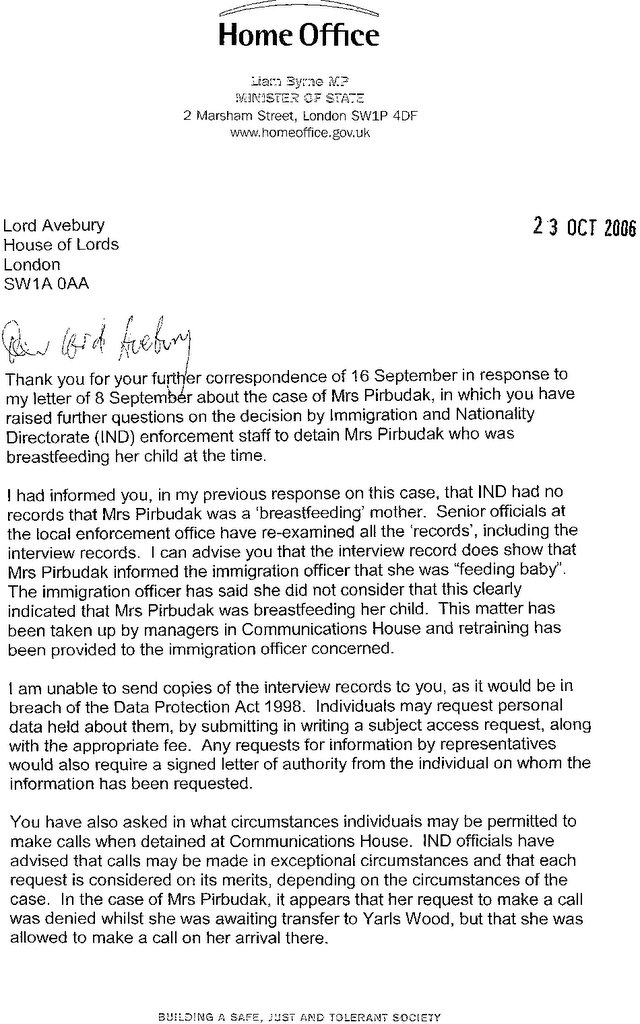
But in a letter to the human rights campaigner and Liberal Democrat peer Lord Avebury, Mr Byrne said records of the case had been re-examined.
The letter written on Monday said: "I can advise you that the interview record does show that Mrs P informed the immigration officer that she was 'feeding baby'. The immigration officer has said she did not consider that this clearly indicated that Mrs P was breastfeeding her child."
The immigration officer, from Communications House, in central London, had since been retrained, Mr Byrne said.
He also revealed that new instructions were to be sent out by the Immigration and Nationality Directorate (IND).
"Specific guidance should be developed in relation to breastfeeding mothers and parents of young children," he said.
"This should include a requirement that breastfeeding children should not be separated from their mothers unless there are compelling and exceptional circumstances which indicate that this may be appropriate."
He added that the same approach should be taken to the separation of any young children from their mothers, regardless of whether they were breastfeeding.
The guidance will state that any decision to separate young children from mothers can only be taken at the level of IND assistant director.
But Lord Avebury said the government should go further.
"There should be an outright ban on separating breastfeeding mothers from their children. I don't see why they should ever have to do it," he said.
He also urged the chief inspector of prison, Anne Owers, and the children's commissioner, Sir Al Aynsley Green, to monitor immigration officials to ensure it did not happen again.
In the meantime, Lord Avebury has written to Ms Owers and Sir Al asking them to investigate how many other women have been separated from young children in the drive to deport failed asylum seekers.
[www.guardian.co.uk/immigration/story/0,,1931318,00.html]
Matt Weaver
Wednesday October 25, 2006
Guardian Unlimited
Immigration officials are to be ordered to stop separating breastfeeding mothers from their babies in the drive to deport failed asylum seekers after the government was told that the practice flouts UN conventions.
In August, Guardian Unlimited revealed that in at least two cases earlier this year mothers had been detained in immigration and removal centres away from their pre-weaned children.
The cases involved Mrs N, a Vietnamese asylum seeker, and her six-month-old baby, and Mrs P, a Turkish asylum seeker, and her 15-month-old infant who she was still breastfeeding on medical advice.
Article continues
Ministers were warned that the cases, which campaigners fear are not the only ones, "fly in the face of a number of UN resolutions and conventions".
The government has now said that it accepts the need for new guidance instructing immigration officials not to separate any young children from their mothers unless there are "compelling and exceptional circumstances".
The immigration minister Liam Byrne previously denied that immigration officials knew Mrs P had been breastfeeding her child.
But in a letter to the human rights campaigner and Liberal Democrat peer Lord Avebury, Mr Byrne said records of the case had been re-examined.
The letter written on Monday said: "I can advise you that the interview record does show that Mrs P informed the immigration officer that she was 'feeding baby'. The immigration officer has said she did not consider that this clearly indicated that Mrs P was breastfeeding her child."
The immigration officer, from Communications House, in central London, had since been retrained, Mr Byrne said.
He also revealed that new instructions were to be sent out by the Immigration and Nationality Directorate (IND).
"Specific guidance should be developed in relation to breastfeeding mothers and parents of young children," he said.
"This should include a requirement that breastfeeding children should not be separated from their mothers unless there are compelling and exceptional circumstances which indicate that this may be appropriate."
He added that the same approach should be taken to the separation of any young children from their mothers, regardless of whether they were breastfeeding.
The guidance will state that any decision to separate young children from mothers can only be taken at the level of IND assistant director.
But Lord Avebury said the government should go further.
"There should be an outright ban on separating breastfeeding mothers from their children. I don't see why they should ever have to do it," he said.
He also urged the chief inspector of prison, Anne Owers, and the children's commissioner, Sir Al Aynsley Green, to monitor immigration officials to ensure it did not happen again.
In the meantime, Lord Avebury has written to Ms Owers and Sir Al asking them to investigate how many other women have been separated from young children in the drive to deport failed asylum seekers.
[www.guardian.co.uk/immigration/story/0,,1931318,00.html]
Wednesday, October 25, 2006

Letter in today's Guardian
Your article (Comment, October 23) misrepresents the House of Lords. Of the 72 new peers appointed since the beginning of this parliament, only 23 take the Labour whip and the rest are Conservatives, Liberal Democrats or crossbenchers. Twenty of them are women, adding to the previous total of 116 women members, including the Lords speaker and the leader of the house.
The ideal member is not one who can pop in from time to time, as he or she might to the board of a cultural institution. The member needs to be able to attend regularly, to deal with legislation in their area of interest and to extract information from the government at question time. We don't want anybody who is looking for "the perfect eventide home".
The ideal member is not one who can pop in from time to time, as he or she might to the board of a cultural institution. The member needs to be able to attend regularly, to deal with legislation in their area of interest and to extract information from the government at question time. We don't want anybody who is looking for "the perfect eventide home".
Yarl's Wood
Question on Yarl's Wood, and in particular on the separation of breastfeeding mothers from their infants:
www.publications.parliament.uk/pa/ld199900/ldhansrd/pdvn/lds06/text/61024-0001.htm#06102454000010
www.publications.parliament.uk/pa/ld199900/ldhansrd/pdvn/lds06/text/61024-0001.htm#06102454000010
Tuesday, October 24, 2006
South China Morning Post
South China Morning Post
Monday, October 23, 2006
SILENCE DEAFENING
There is still a deafening silence from the UK consulate on the position of the many children in Hong Kong who continue to wait for British citizenship certificates after Home Office officials agreed their original applications had been wrongly refused.
There was a time, sadly, when Britain encouraged Indian British National (Overseas) passport holders to look to India to resolve their nationality difficulties. On July 25, 1991, in a debate on the statelessness faced by these people, India's former prime minister Atal Behari Vajpayee told the Indian Parliament that "the attitude of the British government is wrong and is based on apartheid". In the same debate, the Indian minister of external affairs said that "the government has time and again represented to the British government, saying that these people are your citizens and you must take care of them and protect their rights".
The British Nationality (Hong Kong) Act 1997 was enacted only after expressions of concern in both houses of parliament and representations from the governor of Hong Kong, two former incumbents, the Hong Kong Legislative Council, the House of Commons Select Committee on Foreign Affairs, and a former minister with responsibility for the colony. At the time, Britain's prime minister said that the ethnic minorities "were potentially stateless" and that they would "now have a nationality".
After being wrongly refused nine years ago, why have so many applicants been waiting up to eight months, when the Home Office has agreed to process their reconsiderations in five weeks? Why does the British consulate not respond to the many e-mails, telephone calls and letters from affected applicants? What is it doing to help those who have received citizenship certificates which contain errors?
Every six months, Britain's foreign secretary issues a report to Parliament on Hong Kong. The report of February 2003 stated that the British government "regularly raises the lack of racial discrimination legislation as an issue with the Hong Kong government". Perhaps our Foreign Office should take a closer look at our own treatment of Hong Kong's solely British ethnic minorities before trying to preach to others.
LORD AVEBURY, House of Lords, and TAMEEM A. EBRAHIM, London
Monday, October 23, 2006
SILENCE DEAFENING
There is still a deafening silence from the UK consulate on the position of the many children in Hong Kong who continue to wait for British citizenship certificates after Home Office officials agreed their original applications had been wrongly refused.
There was a time, sadly, when Britain encouraged Indian British National (Overseas) passport holders to look to India to resolve their nationality difficulties. On July 25, 1991, in a debate on the statelessness faced by these people, India's former prime minister Atal Behari Vajpayee told the Indian Parliament that "the attitude of the British government is wrong and is based on apartheid". In the same debate, the Indian minister of external affairs said that "the government has time and again represented to the British government, saying that these people are your citizens and you must take care of them and protect their rights".
The British Nationality (Hong Kong) Act 1997 was enacted only after expressions of concern in both houses of parliament and representations from the governor of Hong Kong, two former incumbents, the Hong Kong Legislative Council, the House of Commons Select Committee on Foreign Affairs, and a former minister with responsibility for the colony. At the time, Britain's prime minister said that the ethnic minorities "were potentially stateless" and that they would "now have a nationality".
After being wrongly refused nine years ago, why have so many applicants been waiting up to eight months, when the Home Office has agreed to process their reconsiderations in five weeks? Why does the British consulate not respond to the many e-mails, telephone calls and letters from affected applicants? What is it doing to help those who have received citizenship certificates which contain errors?
Every six months, Britain's foreign secretary issues a report to Parliament on Hong Kong. The report of February 2003 stated that the British government "regularly raises the lack of racial discrimination legislation as an issue with the Hong Kong government". Perhaps our Foreign Office should take a closer look at our own treatment of Hong Kong's solely British ethnic minorities before trying to preach to others.
LORD AVEBURY, House of Lords, and TAMEEM A. EBRAHIM, London
Bulgaria and Romania
Rights of migrant workers from Bulgaria and Romania to come here after accession in January 2007: Reid is getting ready to put up the shutters. www.publications.parliament.uk/pa/ld199900/ldhansrd/pdvn/
lds06/text/61023-0001.htm#06102316000003
lds06/text/61023-0001.htm#06102316000003
Sunday, October 22, 2006
Festival of Lights
Lindsay's Festival of Lights on Friday in the Park was a great success, attended by lots of people, including, here, the Mayor Cllr Liz Atkinson and her husband. There was music, dancing, light shows and fireworks.
Saturday we went to Bromley for Mike Steele's 70th birthday party, a happy occasion, with some old friends including Leo Abse who I think I last saw in 1970. We met his two daughters and grandchildren.
Saturday we went to Bromley for Mike Steele's 70th birthday party, a happy occasion, with some old friends including Leo Abse who I think I last saw in 1970. We met his two daughters and grandchildren.

Thursday, October 19, 2006
Population growth - a threat to development in Africa
7.59 pm
Lord Avebury: My Lords, I echo the congratulations expressed to my noble friend Lord Taverne on his brilliant speech, in which he argued most effectively that a reduction in the rate of population growth is an effective means of promoting development in Africa. That sentiment has been echoed by every other noble Lord who has spoken.
Last year, the UN report on population challenges and development goals concluded that reduction of birth rates led to a “demographic bonus” whereby the number of people of working age increased relative to those of the children and the elderly, contributing significantly to economic growth and poverty reduction. But the UN study of world population prospects in 2004 showed that, over the last 30 years, the lowest reductions in fertility occurred in 12 African high-fertility countries, as has been mentioned. These countries are forecast to have the highest population growth, coupled with the lowest chance of reaching the millennium development goals, particularly as regards infant and maternal mortality and universal primary education.
The Africa Commission said that Africa's population is exploding and that millions are migrating to the slums of cities, where the young are unemployed and disaffected. Yet it fails to link the population explosion with Africa’s underdevelopment or to emphasise the negative feedback between high rates of growth and the acute environmental risks affecting the continent. That point was mentioned by several noble Lords. The commission recommends that donors should do all that they can to ensure universal access to sexual and reproductive services, including the provision of an extra $300 million in commodity requirements. But it offers no suggestions about how to overcome the inertia or obstruction by Governments and religious organisations to these programmes, a matter to which my noble friend Lord Taverne referred.
There have been shortages of condoms in Africa. Last year, there was a particular shortage in Uganda, to which my noble friend referred. I think that that shortage was partly caused by the American plan for AIDS relief driven by the religious right, which emphasises abstinence. The DfID profile on Uganda rightly praises the Government of President Museveni for reducing the prevalence of HIV and AIDS from 18 per cent to 6 per cent in a decade. But many women are still unable to exercise freedom of choice over their own fertility. One-third of Ugandan women say that they would like to stop or postpone having children if they could. They are among the100 million to 200 million whom the noble Viscount,
18 Oct 2006 : Column 855
Lord Craigavon, referred to who want to control their fertility but who do not have the means of doing so.
According to UN estimates—and this was also referred to by my noble friend—Uganda's population may treble from 42 million in 2005 to 127 million in 2050. With similar increases in other countries in that region, climate change—which is linked to population increase, as the noble Lord, Lord Jones, remarked and is likely to reduce agricultural production because of extended desertification, lack of water, loss of soil fertility and reduction of crop yields—could bring about conflicts over resources, mass starvation and large-scale emigration long before the mid-century arrives. Droughts have increased in frequency in the Horn from one in eight years to one in three, and there are too many cattle for the carrying capacity of the people, but too few to feed the increasing number of mouths. In Somalia, the desperation of people living on the edge of survival is already reinforcing the growth of radical Islam. Even war-torn Somalia, without a functioning Government or health service, is estimated to have a population increase from8 million in 2005 to 21 million in 2050, while the combined populations of Kenya and Tanzania will double over the same period to 150 million. It is inconceivable that east Africa can sustain increases of this order.
The question is: what can the countries themselves and the donor community do to avert the looming catastrophe? A far greater emphasis on the MDG of promoting gender equality and empowering women would be an essential part of any strategy, because if women controlled their own fertility they would not have very large families. Bill Gates wrote in the Independent the other day:
“Abstinence is not an option for some poor men and girls who have no choice but to marry at an early age...And using condoms is not a decision that a woman can make by herself; it depends on a man”.
I would argue that abstinence is in any case an unworkable policy and contrary to human nature, but if women themselves decided when to get married and could decide on whether contraceptives should be used, both population growth and HIV/AIDS infections would be reduced, as has been remarked, and women liberated from the burden and health risks of constant childbearing would be able to make a far greater contribution to the economy, especially in agriculture.
In fact, 120 million women in sub-Saharan Africa are illiterate and most African women have less access to land and education than ever before. Elizabeth Chacko of George Washington University points out that Kerala in India has a low fertility rate compared with that of India as a whole because the women of Kerala have a relatively high status, are well educated and are integrated into the workforce. She says that whether a woman can read, can understand what methods of contraception are available to her and is empowered to use them can have a great impact on fertility rates.
DfID says that one of its key priorities is to get more girls into school, leading to greater economic growth, less poverty and reduced fertility, and that is
18 Oct 2006 : Column 856
an important contribution towards attaining the MDG of promoting gender equality. But six years ago DfID also said in an excellent report on poverty and women's empowerment that education alone would not be enough—inequalities needed to be tackled across the board in economic, political, social and cultural life. The Beijing World Conference on Women of 1995 identified 12 critical areas of concern, of which one was unequal access to education and training—one very important one, but not the only one. So I suggest to the Minister that it is time for DfID to review the strategy for poverty elimination and the empowerment of women and to upgrade accordingly its country programmes for Africa. That is not only the right policy for its own sake, but the best way to harness the talent and energies of half the population of Africa and to prevent a Malthusian catastrophe from overwhelming the continent within two generations.
8.7 pm
Lord Avebury: My Lords, I echo the congratulations expressed to my noble friend Lord Taverne on his brilliant speech, in which he argued most effectively that a reduction in the rate of population growth is an effective means of promoting development in Africa. That sentiment has been echoed by every other noble Lord who has spoken.
Last year, the UN report on population challenges and development goals concluded that reduction of birth rates led to a “demographic bonus” whereby the number of people of working age increased relative to those of the children and the elderly, contributing significantly to economic growth and poverty reduction. But the UN study of world population prospects in 2004 showed that, over the last 30 years, the lowest reductions in fertility occurred in 12 African high-fertility countries, as has been mentioned. These countries are forecast to have the highest population growth, coupled with the lowest chance of reaching the millennium development goals, particularly as regards infant and maternal mortality and universal primary education.
The Africa Commission said that Africa's population is exploding and that millions are migrating to the slums of cities, where the young are unemployed and disaffected. Yet it fails to link the population explosion with Africa’s underdevelopment or to emphasise the negative feedback between high rates of growth and the acute environmental risks affecting the continent. That point was mentioned by several noble Lords. The commission recommends that donors should do all that they can to ensure universal access to sexual and reproductive services, including the provision of an extra $300 million in commodity requirements. But it offers no suggestions about how to overcome the inertia or obstruction by Governments and religious organisations to these programmes, a matter to which my noble friend Lord Taverne referred.
There have been shortages of condoms in Africa. Last year, there was a particular shortage in Uganda, to which my noble friend referred. I think that that shortage was partly caused by the American plan for AIDS relief driven by the religious right, which emphasises abstinence. The DfID profile on Uganda rightly praises the Government of President Museveni for reducing the prevalence of HIV and AIDS from 18 per cent to 6 per cent in a decade. But many women are still unable to exercise freedom of choice over their own fertility. One-third of Ugandan women say that they would like to stop or postpone having children if they could. They are among the100 million to 200 million whom the noble Viscount,
18 Oct 2006 : Column 855
Lord Craigavon, referred to who want to control their fertility but who do not have the means of doing so.
According to UN estimates—and this was also referred to by my noble friend—Uganda's population may treble from 42 million in 2005 to 127 million in 2050. With similar increases in other countries in that region, climate change—which is linked to population increase, as the noble Lord, Lord Jones, remarked and is likely to reduce agricultural production because of extended desertification, lack of water, loss of soil fertility and reduction of crop yields—could bring about conflicts over resources, mass starvation and large-scale emigration long before the mid-century arrives. Droughts have increased in frequency in the Horn from one in eight years to one in three, and there are too many cattle for the carrying capacity of the people, but too few to feed the increasing number of mouths. In Somalia, the desperation of people living on the edge of survival is already reinforcing the growth of radical Islam. Even war-torn Somalia, without a functioning Government or health service, is estimated to have a population increase from8 million in 2005 to 21 million in 2050, while the combined populations of Kenya and Tanzania will double over the same period to 150 million. It is inconceivable that east Africa can sustain increases of this order.
The question is: what can the countries themselves and the donor community do to avert the looming catastrophe? A far greater emphasis on the MDG of promoting gender equality and empowering women would be an essential part of any strategy, because if women controlled their own fertility they would not have very large families. Bill Gates wrote in the Independent the other day:
“Abstinence is not an option for some poor men and girls who have no choice but to marry at an early age...And using condoms is not a decision that a woman can make by herself; it depends on a man”.
I would argue that abstinence is in any case an unworkable policy and contrary to human nature, but if women themselves decided when to get married and could decide on whether contraceptives should be used, both population growth and HIV/AIDS infections would be reduced, as has been remarked, and women liberated from the burden and health risks of constant childbearing would be able to make a far greater contribution to the economy, especially in agriculture.
In fact, 120 million women in sub-Saharan Africa are illiterate and most African women have less access to land and education than ever before. Elizabeth Chacko of George Washington University points out that Kerala in India has a low fertility rate compared with that of India as a whole because the women of Kerala have a relatively high status, are well educated and are integrated into the workforce. She says that whether a woman can read, can understand what methods of contraception are available to her and is empowered to use them can have a great impact on fertility rates.
DfID says that one of its key priorities is to get more girls into school, leading to greater economic growth, less poverty and reduced fertility, and that is
18 Oct 2006 : Column 856
an important contribution towards attaining the MDG of promoting gender equality. But six years ago DfID also said in an excellent report on poverty and women's empowerment that education alone would not be enough—inequalities needed to be tackled across the board in economic, political, social and cultural life. The Beijing World Conference on Women of 1995 identified 12 critical areas of concern, of which one was unequal access to education and training—one very important one, but not the only one. So I suggest to the Minister that it is time for DfID to review the strategy for poverty elimination and the empowerment of women and to upgrade accordingly its country programmes for Africa. That is not only the right policy for its own sake, but the best way to harness the talent and energies of half the population of Africa and to prevent a Malthusian catastrophe from overwhelming the continent within two generations.
8.7 pm
Wednesday, October 18, 2006
Opting out of school religion at 16
Lord Avebury: My Lords, it is a pity that the Minister’s amendment was not grouped separately so that we could have a discussion on these matters without becoming involved in all the other weighty discussions which have preceded it. The amendment in the name of the noble Baroness, Lady Turner, is distinct from all the others in that it is concerned with a fundamental issue of human rights, whereas whether you have 25 per cent of the places at a faith school allocated to people who do not belong to that religion is a matter of expediency. However, I agree with all those who have said that we need to consider very carefully how to avoid the divisiveness that may arise in our society through exclusive attendance at faith schools of only members of that religion. However, that is another argument. We are concerned here with the human rights of pupils whether to attend acts of collective worship or lessons of religious education.
I am delighted to see the right reverend Prelate the Bishop of Portsmouth back with us, although I, too, beg to differ with him on this matter. I say to him that it is not a question of having no religious education at all. That is not what the amendment says. It is proposed that only when the child reaches 16, or attains the sixth form, should he or she have a right to opt out of religious education. My youngest son took his GCSEs at 15. He took religious education as part of that course. If this amendment had been in force at the time, it would have made no difference whatever to his appreciation of the religious education which that school offered because he would already have received, in his opinion, all that was necessary of such education by the time he took his GCSEs. He did not go on to study RE at A-level, which was his absolute right. It should be the right of any child, as the noble Baroness said.
The noble Baroness is to be particularly congratulated on her deployment of the case to which the JCHR alerted us only at the end of last week. That in turn involved some very rapid footwork by
17 Oct 2006 : Column 725
the committee working during the Recess to pick up the fact that the Government’s amendment, giving a sixth-form pupil the right to be excused attendance at religious worship, is only a quarter of a human rights loaf, as the noble Baroness has explained.
Following amendments by my noble friend Lady Walmsley in Committee, the Government sent out a consultation document on 10 August asking recipients to respond by 25 August, breaking the normal rule of consultations that six weeks are allowed for reply. An explanation should have been given for the shorter timescale, but was not, although I understand from the Government that this was not a normal consultation at all but simply a request for views to be expressed by those immediately concerned. I should like to know who was immediately concerned. On the previous amendment my noble friend mentioned the right of children to express opinions. Did the Minister obtain the opinions of any children, or of organisations representing children? We should hear what they had to say.
It was even more unfortunate that although the noble Lord, Lord Adonis, said in response to my noble friend in Committee on 18 July that he would encapsulate “most of the spirit” of my noble friend’s amendments in the amendment that he would propose, the consultation document referred only to half of it, limiting itself to the question of attendance at collective acts of worship and leaving out altogether any reference to religious education. The noble Lord’s explanation for that in a letter to the executive director of the National Secular Society was,
“that there is a proper distinction to be drawn between participation in religious worship and attendance at religious education lessons on the grounds of the nature of those activities”.
He did not go on to explain the difference in the nature of those two activities. Even if there is such a distinction, as the noble Baroness, Lady Turner, has explained, the rights of parents to opt out of both on behalf of their children are the same, or they are similar if not identical. If there is a proper distinction to be drawn in this legislation, would it not have been right to explain in the consultation document how the Government saw it and get the views of the consultees rather than giving the impression that only the attendance at religious worship had been entered into in Committee, and that there had been no reference to the question of attendance at RE lessons?
8 pm
I think that the Government were at fault in not expanding the consultation to include all the matters dealt with in the amendments in that group in Committee. The Minister’s excuse for not doing so was that my noble friend did not actually refer to this issue in Committee. That is disingenuous. As my noble friend explained, that was a monster group of amendments, and she would have been unpopular if she had spoken to every single one.
In tabling their amendments, the Government concede that a sixth-form pupil of whatever age is competent to decide whether to attend collective worship. As the noble Baroness has explained, the
17 Oct 2006 : Column 726
JCHR says that it is a denial of the rights of the child under both the ECHR and the United Nations Convention on the Rights of the Child to say that she can withdraw from collective worship but not from compulsory RE if she is of sufficient maturity, intelligence and understanding. If she is accepted as having reached that standard for the first, it follows that she is for the second purpose as well. The Government’s position is illogical in arguing that the parents ought to step aside on worship but to continue to decide for the child on RE. The two must go together, and the test for both must be the same.
The JCHR suggests that schools should apply the Gillick test, under which the High Court ruled that a girl of whatever age had the legal capacity to consent to medical examination and treatment, including contraceptives, if she had sufficient maturity and intelligence to understand the nature and implications of the proposed treatment. It says that schools are familiar with this concept and could be provided with guidance on how to apply it in the case of religious worship and RE. However, to avoid what I see as being unnecessary bureaucracy, and because the attainment of the age of 16 and reaching sixth form are objective tests that the Government recognise in their own amendment, it is appropriate to apply them in this context but with the difference that if either of them is satisfied the exercise of choice is triggered. Otherwise, 16 year-olds will be divided into sheep and goats; those who go to a decent school will qualify because they have reached sixth form by that time, while the 44 per cent of pupils who do not achieve five good GCSEs by age 16, as the noble Lord writes in an article in today’s Guardian, will be disqualified.
I agree with the JCHR that it is valuable for children to learn about spiritual and moral issues but, as it adds, there is no guarantee that in a particular school the way RE is taught may not infringe the pupil’s right to freedom of thought, conscience and religion. With the growth of faith schools, about which our Prime Minister is so enthusiastic even though it is an intrinsically divisive idea which is likely to cause untold harm, it is vital that children should be able to protect themselves. My noble friend and others have referred to the UK Government’s obligation to report to the UN Committee on the Rights of the Child in 2007. They will be asked on that occasion whether they have sought the views of children on these proposals and why, if that is the case, they did not accept the weighty advice of the JCHR.
I am delighted to see the right reverend Prelate the Bishop of Portsmouth back with us, although I, too, beg to differ with him on this matter. I say to him that it is not a question of having no religious education at all. That is not what the amendment says. It is proposed that only when the child reaches 16, or attains the sixth form, should he or she have a right to opt out of religious education. My youngest son took his GCSEs at 15. He took religious education as part of that course. If this amendment had been in force at the time, it would have made no difference whatever to his appreciation of the religious education which that school offered because he would already have received, in his opinion, all that was necessary of such education by the time he took his GCSEs. He did not go on to study RE at A-level, which was his absolute right. It should be the right of any child, as the noble Baroness said.
The noble Baroness is to be particularly congratulated on her deployment of the case to which the JCHR alerted us only at the end of last week. That in turn involved some very rapid footwork by
17 Oct 2006 : Column 725
the committee working during the Recess to pick up the fact that the Government’s amendment, giving a sixth-form pupil the right to be excused attendance at religious worship, is only a quarter of a human rights loaf, as the noble Baroness has explained.
Following amendments by my noble friend Lady Walmsley in Committee, the Government sent out a consultation document on 10 August asking recipients to respond by 25 August, breaking the normal rule of consultations that six weeks are allowed for reply. An explanation should have been given for the shorter timescale, but was not, although I understand from the Government that this was not a normal consultation at all but simply a request for views to be expressed by those immediately concerned. I should like to know who was immediately concerned. On the previous amendment my noble friend mentioned the right of children to express opinions. Did the Minister obtain the opinions of any children, or of organisations representing children? We should hear what they had to say.
It was even more unfortunate that although the noble Lord, Lord Adonis, said in response to my noble friend in Committee on 18 July that he would encapsulate “most of the spirit” of my noble friend’s amendments in the amendment that he would propose, the consultation document referred only to half of it, limiting itself to the question of attendance at collective acts of worship and leaving out altogether any reference to religious education. The noble Lord’s explanation for that in a letter to the executive director of the National Secular Society was,
“that there is a proper distinction to be drawn between participation in religious worship and attendance at religious education lessons on the grounds of the nature of those activities”.
He did not go on to explain the difference in the nature of those two activities. Even if there is such a distinction, as the noble Baroness, Lady Turner, has explained, the rights of parents to opt out of both on behalf of their children are the same, or they are similar if not identical. If there is a proper distinction to be drawn in this legislation, would it not have been right to explain in the consultation document how the Government saw it and get the views of the consultees rather than giving the impression that only the attendance at religious worship had been entered into in Committee, and that there had been no reference to the question of attendance at RE lessons?
8 pm
I think that the Government were at fault in not expanding the consultation to include all the matters dealt with in the amendments in that group in Committee. The Minister’s excuse for not doing so was that my noble friend did not actually refer to this issue in Committee. That is disingenuous. As my noble friend explained, that was a monster group of amendments, and she would have been unpopular if she had spoken to every single one.
In tabling their amendments, the Government concede that a sixth-form pupil of whatever age is competent to decide whether to attend collective worship. As the noble Baroness has explained, the
17 Oct 2006 : Column 726
JCHR says that it is a denial of the rights of the child under both the ECHR and the United Nations Convention on the Rights of the Child to say that she can withdraw from collective worship but not from compulsory RE if she is of sufficient maturity, intelligence and understanding. If she is accepted as having reached that standard for the first, it follows that she is for the second purpose as well. The Government’s position is illogical in arguing that the parents ought to step aside on worship but to continue to decide for the child on RE. The two must go together, and the test for both must be the same.
The JCHR suggests that schools should apply the Gillick test, under which the High Court ruled that a girl of whatever age had the legal capacity to consent to medical examination and treatment, including contraceptives, if she had sufficient maturity and intelligence to understand the nature and implications of the proposed treatment. It says that schools are familiar with this concept and could be provided with guidance on how to apply it in the case of religious worship and RE. However, to avoid what I see as being unnecessary bureaucracy, and because the attainment of the age of 16 and reaching sixth form are objective tests that the Government recognise in their own amendment, it is appropriate to apply them in this context but with the difference that if either of them is satisfied the exercise of choice is triggered. Otherwise, 16 year-olds will be divided into sheep and goats; those who go to a decent school will qualify because they have reached sixth form by that time, while the 44 per cent of pupils who do not achieve five good GCSEs by age 16, as the noble Lord writes in an article in today’s Guardian, will be disqualified.
I agree with the JCHR that it is valuable for children to learn about spiritual and moral issues but, as it adds, there is no guarantee that in a particular school the way RE is taught may not infringe the pupil’s right to freedom of thought, conscience and religion. With the growth of faith schools, about which our Prime Minister is so enthusiastic even though it is an intrinsically divisive idea which is likely to cause untold harm, it is vital that children should be able to protect themselves. My noble friend and others have referred to the UK Government’s obligation to report to the UN Committee on the Rights of the Child in 2007. They will be asked on that occasion whether they have sought the views of children on these proposals and why, if that is the case, they did not accept the weighty advice of the JCHR.
Saturday, October 14, 2006
BandarGate continued
Last week I chaired a press conference for Dr Salah al-Bandar, who had published a report on a secret $2.6 million dirty tricks organisation in Bahrain. Now, 100 prominent leaders of Bahraini society have petitioned the King Of Bahrain
regarding the sectarian plan and its ramifications, see www.bahrainrights.org/pressreleases
regarding the sectarian plan and its ramifications, see www.bahrainrights.org/pressreleases
Subscribe to:
Posts (Atom)