Wednesday, August 16, 2006

Wikipedia (from which the image is copied) says:

Hugh tried to starve himself before his trial, but face trial he did on November 24, 1326, in Hereford. He was judged a traitor and a thief, and sentenced to public execution by hanging, drawing and quartering. Being a traitor was also what Gaveston had been executed for as the belief was that these men had misled the King rather than the King himself having created the folly. Immediately after the trial, he was dragged behind four horses to his place of execution at Hereford, where a great fire was lit. The queen watched, with Mortimer, as Despenser was stripped naked, swung up in the air by a noose around his neck, and hanged from a ladder fifty feet high, but cut down before he could choke to death and tied to a ladder, in full view of the crowd. A man climbed up beside him, and sliced off his penis and testicles which were then burnt before him, still alive and conscious. Subsequently, the executioner plunged his knife into his abdomen, and cut out his entrails and heart, which were likewise burnt before the delighted crowd. Finally, he was beheaded, and his body cut into four pieces, and his head was mounted on the gates of London.

No book-length biographical study of Hugh Despenser exists, although The Tyranny and Fall of Edward II: 1321-1326 by historian Natalie Fryde is a study of Edward's reign during the years that the Despensers' power was at its peak. Fryde pays particular attention to the subject of the Despensers' ill-gotten landholdings. The numerous accusations against the younger Despenser at the time of his execution have never been the subject of close critical scrutiny, although historian Roy Martin Haines called them "ingenuous" and noted their propagandistic nature.

Despite the crucial and disastrous role he played in the reign of Edward II, Despenser is almost a minor character in Christopher Marlowe's play Edward II, where as "Spencer" he is little more than a substitute for the dead Gaveston.

According to Alison Weir (Isabella, She-Wolf of France, Queen of England, Pimlico, 2006, 240)

"Despenser... at first suffered with great patience, asking forgiveness of the bystanders, but then a ghastly, inhuman howl broke from him".

Execution of Hugh le Despenser, November 26, 1326


Tuesday, August 15, 2006

See picture below

This is a miniature of Edmund Crouchback with St George, from Bodleian MS Douce 231. Scanned from Four Golden Kings ed Elizabeth Hallam. Edmund, son of Henry III and Eleanor of Provence, b Jan 16, 1265, d June 5, 1296. Married Blanche d'Artois. Further details in Lyulph's Generations file, see below.

Yesterday 1-1, today 2-1 to me, making the series 40-38 to JW.

Edmund Crouchback, 2nd son of Henry III and Eleanor of Provence

Monday, August 14, 2006

Frequent Movers

From Lord Avebury P0612084

Tel 020-7274 4617
Email ericavebury@gmail.com

August 12, 2006


I have seen the report Moving On: Reconnecting Frequent Movers, [FM] which was published after Parliament rose for the summer recess, (www.communities.gov.uk/index.asp?id=1501769) and I can well understand why the DCLG and government as a whole may have been pleased for it to have escaped attention. Did we need to be told, for instance, that in comparison to non movers, frequent movers feel less like part of the community, or that pupils who stay at the same school for all their secondary education were much more likely to achieve 5 GCSE passes than those who joined later?

I was expecting FM to say something about Gypsies and Travellers, but there is merely one short paragraph (3.9) which adds nothing to our knowledge of the problems. I gather that no further publication of material on Gypsies and Travellers arising from the project is intended, and would be grateful if you would let me know the estimated cost of the work done on FM including publication.

In paragraph 5.8 of FM, where reference is made to the government’s strategy for preventing homelessness, the opportunity of reminding local authorities of their responsibility under S 3 of the Homelessness Act 2002, to formulate a strategy for preventing homelessness, and to secure that sufficient accommodation is and will be available for people who are or may become homeless, has been missed. Of the 152 authorities where there were unauthorised Gypsy encampments in the previous January’s ODPM count whose strategies were checked in August 2003, 107 or 70.4% did not mention Travellers. Many of the authors of the Strategies appear to be unaware of S 175 of the Housing Act 1996, which specifically identifies Travellers on unauthorised sites as homeless, although it was referred to in the ODPM’s Code of Guidance para 11.40 (www.gypsy-traveller.org.pdfs/homeless.pdf). Has anything been done to remind local authorities of that definition, and suggest that they update their homelessness strategies accordingly?
.
The final section of FM, Conclusion and next steps, does not contain any proposals for improving the situation of Gypsies and Travellers, who are often involuntary frequent movers because they get moved on from one unauthorised site to another. It is the shortage of sites, caused partly by the repeal of the Caravan Sites Act 1998 in the Criminal Justice and Public Order act 1994, which causes these movements, as we predicted at the time. The problem has been analysed frequently since then, for example by Pat Niner eight years ago (The provision and condition of local authority Gypsy/Traveller sites in England, ODPM, October 2002), but a comprehensive solution must await the completion by local housing authorities of the Gypsy and Traveller accommodation needs assessments required by S 225 of the Housing Act 2004, and the subsequent formulation of local development documents under the Planning Act 2004 specifying the areas which are to be used for the purpose of providing that accommodation. This process will take some years, and it would have been useful if FM had said that, and had recommended that in the meanwhile local authorities should exercise their powers of eviction from unauthorised sites sparingly, and with due regard to the health, welfare and educational needs of the residents, as required by law.

In the case of BATH & NORTH EAST SOMERSET COUNCIL, Claimant, and EILEEN CONNORS & Ors, Defendant, ([2006] EWHC 1595 (QB), Case No: TLQ/06/0321), decided in the High Court on July 5, 2006, the order for removal from the land in question of all caravans, sheds and portable toilets stationed thereon within three months, sought by the claimant was granted, but suspended for four months, and Mr Justice Tugendhat said that interference with the Article 8 rights of the Defendants and their families which would be involved in their being required to leave the site would not be proportionate unless and until this court were able to conclude that specific alternative provision had been made for their needs which the court considered to be sufficient to satisfy that condition, and that if this had not happened, the defendants could make a further application for the suspension of the order.

In this judgement, Mr Justice Tugendhat made detailed reference to Circular 1/06, which provides that where there is clear and immediate need, for instance evidenced through the presence of significant numbers of unauthorised encampments or developments, local planning authorities should bring forward DPDs containing site allocations in advance of regional consideration of pitch numbers, and completion of the new GTAAs. Why did FM not call attention to the requirements of Circular 1/06, and since Regional Planning Boards are likely to wait until all the GTAAs in their region have been completed before allocating pitch numbers to districts, is not this particular provision of the Circular of general importance?

The Planning Inspectorate’s decision to allow appeals by Gypsies in Basildon (APP/V1505/A/05?1183093 etc, June 26, 2006), is relevant to other decisions by authorities which had relied on existing Local Plan frameworks not informed by a needs assessment. The Planning Inspectorate letter to local authorities of July 24, 2006 (PINS 20/9/34) makes it clear that if a recent GTAA is not submitted with other documents, there will have to be an explanation for the omission. But are there other appeals in the pipeline where the local authority has not provided all the information required by this letter including the GTAA? In those cases, does the Inspectorate have power to adjourn the hearing, pending the provision of the information by the local authority, so that money isn’t wasted on legal fees?

In the particular case of Essex, where there were 442 caravans on unauthorised sites at the latest count, the GTAA which has been published since this appeal (www.rochford.gov.uk/rochforddcinternet/PDF/Pla_GypsyTravellerAccomNeedsAssess.pdf) calculated that household formation by 2016 would mean an additional requirement of 59 pitches. Since the GTAAs in the Eastern Region were conducted using different methodologies, there needs to be some way of ensuring that the numbers in each of the separate GTAAs are in conformity with each other, and the same problem is likely to have occurred in other regions, where a variety of consultants may have been employed on different sub-regions. I would be grateful if you could let me know how this is to be done, and how it is intended to secure uniformity of the assessments between regions?


Ms Meg Munn MP,
Department of Communities & Local Government,
Eland House,
Bressenden Place,
London SW1E 6DH
Omrie Golley

From Lord Avebury P0613082

Tel 020-7274 4617
Email ericavebury@gmail.com


August 13, 2006

Dear David,

I attach a medical report on Omrie Golley, a former spokesperson for the RUF who has been in custody in Freetown since January 13, 2006 on charges of treason, and conspiracy to murder the vice-president, Solomon Berewa. He was refused bail on July 24 by a vacation judge, who did not look at the medical report, and it was reported in the Concord Times of July 25 that the British High Commission had expressed concern about his health, but the report added that he was a dual British/Sierra Leone citizen.

I am aware that under the Vienna Convention on Consular Relations, we would have no locus to make official representations on behalf of a dual citizen. However, under the law of Sierra Leone a person who takes any other citizenship forfeits his Sierra Leone citizenship. Therefore Mr Golley is a British citizen only, and we should make formal representations to the Sierra Leone authorities to see that he receives proper medical attention. At the very least he should be given appropriate medication, for example to reduce his high blood pressure, but I think we should support a new bail application at which another vacation judge could be invited to consider the medical report, with a view to having Mr Golley transferred to hospital, as would be normal, I hope, where a prisoner is ill enough to justify it.


The Lord Triesman,
Foreign & Commonwealth Office,
London SW1A 2AH.

Asylum (Designated States)

From Lord Avebury P0613081

Tel 020-7274 4617
Email ericavebury@gmail.com


August 13, 2006

Dear Mr Byrne,

In the debate on the Asylum (Designated States)(No 2) Order 2005 on November 24, 2005, I asked Steve Bassam (col 1812) whether the Secretary of State would agree to refer the question of partial designation in respect of gays, in particular in the case of Jamaica, to the advisory panel, and he said this was

‘a valid point which I am sure will be relayed to the Home Secretary’.

However, I never had any official comment on the proposal, and would be grateful if you could let me know whether it was ever referred to the Secretary of State, and with what outcome?

I was reminded of this matter by an Amnesty International Urgent Action on Cameroon (AFR 17/003/2006 of July 7, 2006) about a group of young men who had been detained on account of their sexual orientation on Yaoundé. One of them died shortly after he was released, from an illness he had contracted before his detention, though one doesn’t imagine he received proper medical attention while in custody. Seven others were found guilty of practising homosexuality and two were acquitted, but all none spent 10 months in prison. Amnesty International comments that homophobia is endemic in Cameroon.

There is no regular COI report on Cameroon, but the number of principal applications from Cameroon in Q1 2006, the latest quarterly figures, was exactly the same as the number from Algeria, which does have a COI twice yearly report. On the RDS site there is a report of a fact-finding mission of January 17-25, 2004, according to which the British High Commission ‘knew of few, if any, cases of prosecution [under Article 347a of the Penal Code]’. Will you please see that a note is added to the mission report giving details of the Amnesty International UA, and of any other cases which may have been reported since January 2004? Otherwise, there is a risk that immigration judges and practitioners might be misled by the out of date statement quoted.

Yours sincerely,


Liam Byrne Esq MP,
Home Office,
2 Marsham Street,
London SW1P 4DF

Friday, August 11, 2006

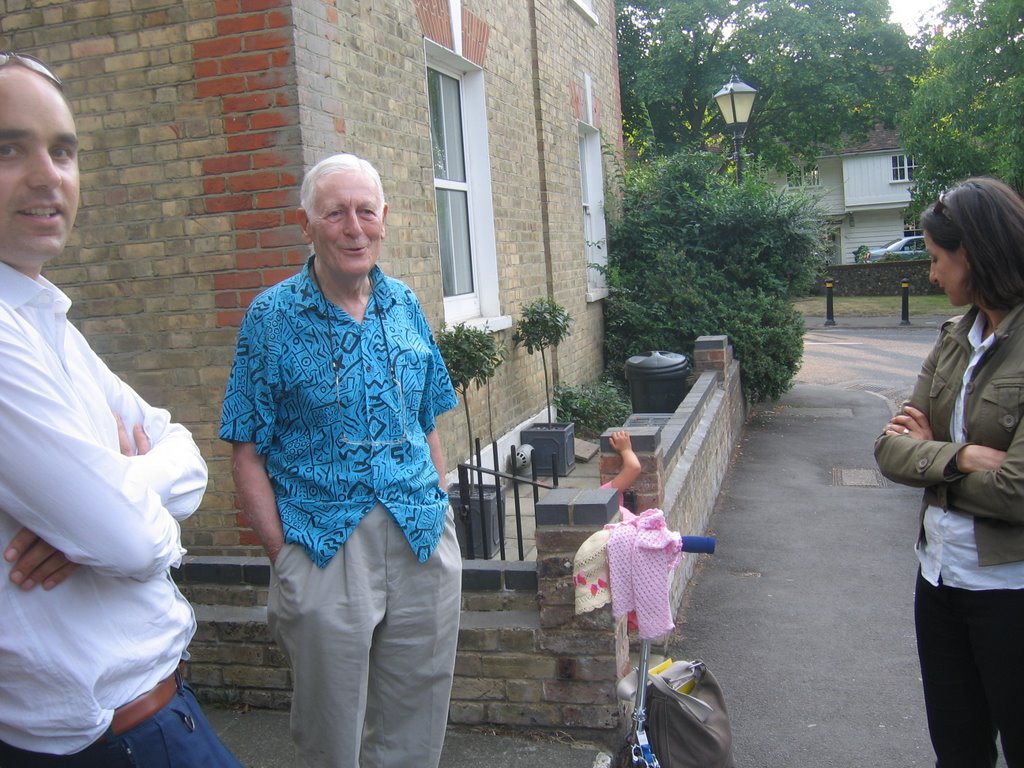
Lyulph about to start his talk in the Village Hall

Outside the Downe Village Hall, with Ischtar and James Newsome

One more from Brittany - the end of Castle Canute

Some of the 100 decendants of our grandfather Sir John Lubbock on the lawn at High Elms, August 5

Update

First things first. Since the last tally when JW was leading 35-30 we had a 1-1 draw at Erquy; then on JW's birthday, I won 3-0, and today he won 2-1 making it 38-35.

Today I saw Mr M, the surgeon, who was satisfied with my progress and doesn't want to see me again. He said he had asked for the photographs of the operation to be put on a CD and sent to me, and had wiped them off his hard disk. But this hadn't been done, and fortunately they would still be in the recycle bin. So they should be there and this time round, I hope they will be safely retrieved and sent.

Last Saturday was the annual High Elms picnic and Lyulph's great exhibition and lecture in the Downe Village Hall on the history of High Elms. Most unfortunately the memory card in our camera decided to pack up, so I'm relying on others to send me pictures of the event. JW took some, which I'll post in a minute. For Lyulph's
High Elms website www.highelms.info and for Ken Timbers' excellent photographs, web.mac.com/katim/iWeb/katim

On Wednesday Lyulph and I went to Welbeck Abbey to see the Hayter pastels of my great-great grandmother Adelaide Kemble in various operatic roles, plus an enormous portrait of her as Norma by Sir Francis Grant in 1842, the year she married Edward Sartoris, all commissioned by the eccentric 5th Duke of Portland when he was still the Marquess of Titchfield. He is said to have proposed to her in 1842, but there is no correspondence or any other record, or even of the Duke having been to see her on the stage. A groupie who was equally obsessed with Adelaide, Anna Jameson, wrote a description of each of the scenes in the Hayters, and presumably her published works have been trawled to see if they provide any clues. The only other line of inquiry that occurs to us is to find out whether Hayter or Grant left any papers.

Friday, August 04, 2006

Lets see what he has to say

From Lord Avebury P0622072

Tel 020-274 4617
Email ericavebury@gmail.com


July 22, 2006


Thank you for your letter of July 12 about the prohibition of the JKLF in the Azad Kashmir elections.

You say this is an internal issue, but you have also said that the wishes of the people of Kashmir should be taken into account in a lasting solution of the dispute over Kashmir [Feb 27, 2006 306W] and that ‘there can be no agreement without the involvement of the people of Kashmir [June 21, 2006, col 649]. Please can you explain how the wishes of the people are to be ascertained, when the authorities on both sides of the LoC prohibit the articulation of a particular view on the future constitutional status of the State of Jammu and Kashmir? It is likely that candidates who advocate the independence of the State would receive a substantial vote in Azad Kashmir if they were allowed to stand, so why do you consider this to be an internal issue, when it is clearly a necessary condition for the wishes of the people to be ascertained?


Dr Kim Howells MP,
Foreign & Commonwealth Office,
London SW1A 2AH.

Was the banning of the JKLF from the Azad Kashmir election an internal matter?

Thursday, August 03, 2006

With Bangladeshi friends at the Dilchad Restaurant this evening

Situation in Somalia: letter to the Minister

From Lord Avebury P0603081

Tel 020-7274 4617
Email ericavebury@gmail.com


August 3, 2006

Dear David,

Thank you for your letter of July 28, ref 32458, about the situation in Somalia.

For the time being, there is no fighting, because the Islamists control most of the territory outside Somaliland, Puntland and the Baidoa enclave. The Islamists are unlikely to attack Baidoa, because they wouldn’t like the Ethiopians to have any excuse for keeping their troops on Somali soil. Where we disagree is that you continue to believe in the face of the evidence that the TFIs provide the basis for a solution, which can evolve through dialogue between the Islamic Courts and the TFG.

For a start, Sheikh Hassan Dahir Aweys has ruled out talks with the TFG as long as a single Ethiopian soldier remains in Somalia (Reuters, July 30), and the UN Envoy Francois Lonseny Fall has confirmed that some Ethiopian forces are in Baidoa and Wajid (Reuters Foundation, July 26). But the Islamists are not really interested in talks when they have nothing to gain from sharing the power they already wield.

The longer the talks are delayed, the weaker the TFG becomes. On July 27, 18 members of the TFG cabinet resigned; the next day the Minister for the Constitution and Federalism, Abdalla Deerow Isaq, was shot dead as he left a mosque; on July 30 the Prime Minister lost a non-confidence vote by 126-88, but stayed in post because the motion needed a two thirds majority; on August 1 another six or 11 Ministers resigned, depending on which source you prefer. Sheikh Aweys said he appreciated their action and called on the rest of the Ministers to resign (Somalia: Islamists Applaud as 11 Government Ministers Quit Posts, Shebelle Media Network, August 2). The Minister of Defence resigned today, bring the total who have quit so far to 37 out of 102 Ministers. Squabbles have broken out between Yusuf and Speaker Aden on the one hand, and Gedi’s faction on the other, about whether to attend the Arab League meeting which is not going to take place anyway.

Meanwhile, militiamen controlling 50 ‘technicals’, who were supposed to be guarding Baidoa, have defected to the Islamists. An Ethiopian Minister has said that the Islamists are a terrorist group, and that the international community should support the TFG to ‘combat’ the movement in the region.

The presence of Ethiopian forces in Baidoa may provide the few remaining loyalists of the TFG security against a direct attack by the Islamists, but Aweys can afford to wait. Probably within weeks rather than months, Yusuf, Gedi and anybody else who hasn’t already thrown his lot in with the Islamists will be airlifted to safety. The Islamists will be in effective control of the country and will have to be recognised as the legitimate government. There is no point in continuing to call on the parties to resume the Arab League talks, because there will be only one side left.

As for your suggestion that Somalia should retain ownership of the peace process, when there is a de facto government which has a monopoly of armed force, as there will be, there will no longer be a process to be owned. The people of Somalia will have to submit to Mr Aweys, unless of course they have the resources to flee the country and seek asylum, as many will try to do. There are already 148,000 Somali refugees in the camps in Kenya, and 16,000 in Ethiopia, but some will no doubt get to the UK.

According to the US State Department, terrorists who were involved in the 1998 bombings of the US Embassies in Kenya and Tanzania are being sheltered by elements within the Islamists, and there is a terrorist organisation known as al-Ittihad al-Islami which aims at establishing a Salafist emirate in Somalia. Sheikh Aweys himself is said to have links to al-Qa’eda, but denies any formal connection. He has said he ‘partially agrees’ with comments ascribed to bin Laden about Somalia being an ‘open front’ against the US, and it is hard to imagine the US having any dealings with a régime led by Aweys.

I do recognise that we have only a minor role to play in these events, but I suggest that we at least refrain from making ourselves look silly by continuing to press for the grandiloquently misnamed TFG and the Islamists. Nor would there be any need for an African-led Peace Support Operation if the Islamists say they can maintain law and order, as it appears they have done in Mogadishu. An alternative would be to put resources into helping Somaliland towards strengthening its democratic institutions and its economy, so that there is a model for Somalis in shaping their own political future. It may well be that they have no more choice under Mr Aweys that they have done for the last 15 years under the warlords, but there would be no justification under international law for using military force to prevent what is almost a fait accompli; a call by the TFG for Ethiopian military assistance would not be a valid exercise of Article 51 of the UN Charter, and if the Ethiopians are there at the invitation of ‘President’ Yusuf, he has not complied with the obligation to report it to the Security Council.


The Rt Hon the Lord Triesman,
Foreign & Commonwealth Office,
London SW1A 2AH.